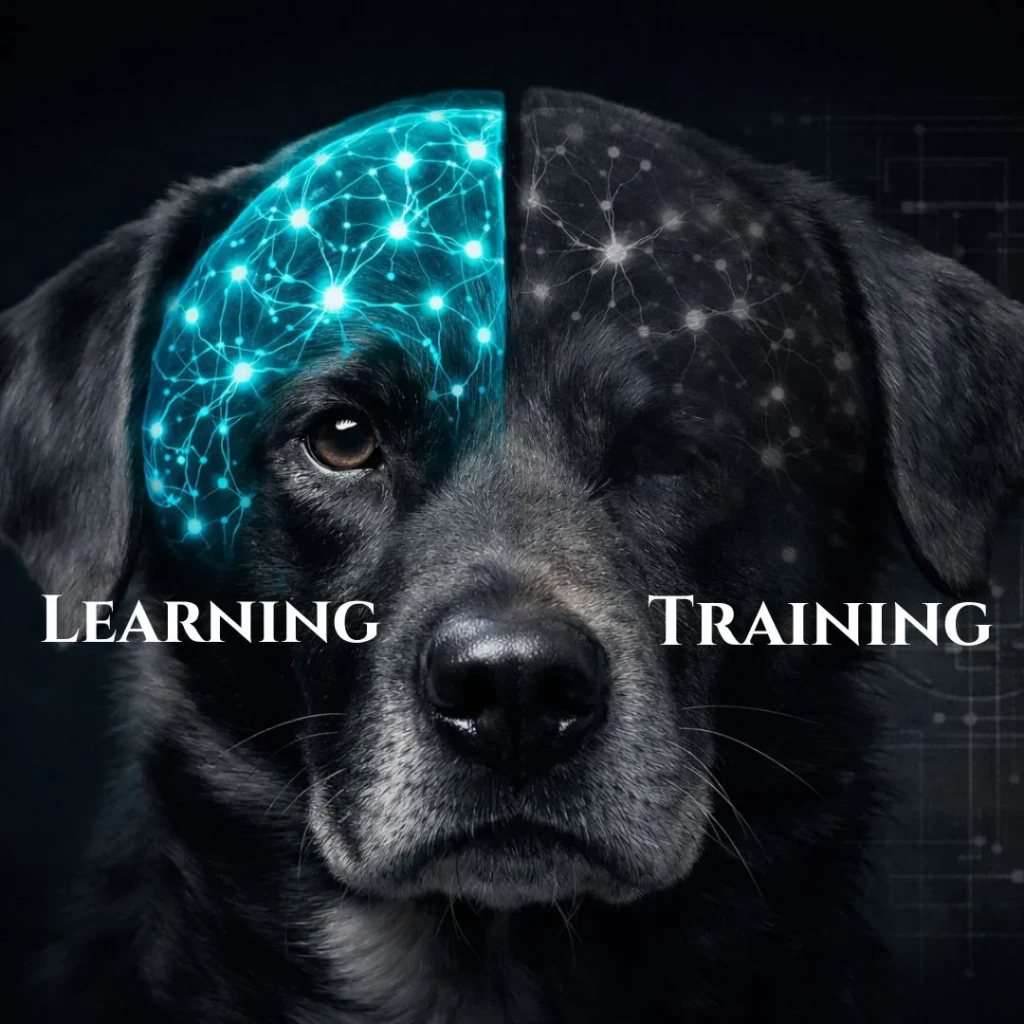
Why Conditioning Shrinks a Dog’s Mind
(And Why Trainers Don’t Want to Talk About It)
Training isn’t learning — it’s conditioning.
And conditioning doesn’t build a dog’s mind, it shuts it down.
This article explains why automated behaviors require no cognition, why the brain stops supporting unused neural pathways, and how obedience creates predictable responses at the cost of curiosity, resilience, and emotional presence. If you think a well-trained dog is a smart dog, this will change everything.
Training doesn’t teach. It replaces thinking with reflex.
Most people believe training is learning.
It isn’t.
Training is conditioning — and conditioning is the art of shutting down cognition and replacing it with automatic responses.
This isn’t an insult.
It’s neuroscience.
Learning creates new neural pathways.
Conditioning eliminates the need for them.
Training is not education.
Training is automation.
And once you see that clearly, everything about the dog world suddenly makes sense.
Let’s break it apart — clean, clinical, unforgiving.
1. Learning and conditioning are opposites
Learning requires:
- curiosity
- exploration
- problem-solving
- decision-making
- emotional engagement
- cognitive flexibility
- processing new information
Conditioning requires none of that.
Conditioning is:
stimulus → response → reward/punishment → repetition → automation.
It’s reactive, not reflective.
It’s mechanical, not cognitive.
It’s execution, not understanding.
Learning expands the brain.
Conditioning bypasses it.
2. Automatic behaviors don’t require thinking —
and the brain stops supporting what it doesn’t use**
Neuroscience is painfully simple:
Use it or lose it.
When a behavior becomes automated:
- cortical activity drops
- metabolic demand decreases
- neurons stop firing
- synaptic pathways weaken
- cognitive engagement shuts down
The dog becomes more predictable —
because he becomes less mentally present.
This is why highly trained dogs:
- stare blankly
- move mechanically
- stop exploring
- lose spontaneity
- show less communication
- break under pressure
- freeze or dissociate when confused
Training didn’t make them smarter.
It made them simpler.
3. Trainers love conditioning because it produces control, not cognition
Training audiences want:
- obedience
- compliance
- “good dogs”
- immediate results
- predictable behavior
- easy-to-measure progress
Conditioning provides all of that.
It strips away:
- agency
- variability
- self-regulation
- authentic communication
- emotional nuance
It replaces a dog with a response machine.
And the industry calls this “well-trained.”
But it’s not well-trained.
It’s well-suppressed.
4. Conditioning punishes the exact systems trauma needs to heal
Trauma healing requires:
- exploration
- emotional expression
- safety signals
- curiosity
- micro-corrections
- nervous-system flexibility
- relational regulation
Training demands:
- stillness
- suppression
- compliance
- focus on commands
- pressure tolerance
- ignoring internal states
Everything trauma needs, training shuts down.
Everything training needs, trauma removes.
There is no overlap.
5. Automation = cognitive shrinkage
Humans think a dog who performs flawlessly is:
- intelligent
- disciplined
- “in a good state of mind”
- learning well
But dogs don’t get smarter through conditioning.
They get narrower.
Automation shrinks:
- behavioral repertoire
- emotional expression
- problem-solving ability
- adaptability
- resilience
- social communication
- thinking time
A conditioned dog is easy to handle —
but incapable of self-regulation.
A thinking dog is harder to handle —
but capable of actual learning.
The industry wants the first.
RN works for the second.
6. Conditioning creates blind spots — for dogs AND humans
When a dog learns:
- sit
- stay
- heel
- focus
- ignore
- perform
- comply
…he also learns to:
- suppress discomfort
- override stress signals
- disconnect from instinct
- ignore his own needs
- hide dysregulation
- silence communication
This is not learning.
It is a progressive loss of connection to the dog’s environment, his body, and his human.
A conditioned dog is easier to handle because he has stopped participating in the relationship.
7. Why trainers avoid this topic like fire
Because admitting the truth means admitting that:
- most “success stories” are shutdown
- most “calm dogs” are dissociated
- most “obedience” is suppression
- most “learning” never happened
- the entire framework is built on cognitive bypassing
It means acknowledging that training doesn’t elevate dogs —
it simplifies them.
And people who build careers on conditioning cannot afford that conversation.
8. RN’s stance: Dogs are not machines to be programmed
RN does not:
- automate
- suppress
- segment
- reward collapse
- punish communication
- replace cognition with reflex
RN:
- expands neural pathways
- builds regulation
- increases flexibility
- protects agency
- supports problem-solving
- encourages exploration
- strengthens attachment
- fosters real learning
Training narrows a dog.
RN deepens him.
Training makes dogs compliant.
RN makes dogs whole.
Conclusion — Conditioning doesn’t teach.
It erases.
Training doesn’t elevate a dog’s mind —
it simplifies it until the dog becomes predictable enough for human comfort.
But the dog loses:
- curiosity
- flexibility
- nuance
- resilience
- emotional presence
- self-regulation
- authentic communication
Conditioning turns living beings into obedient systems.
RN turns living beings into themselves.
If you want a machine, train it.
If you want a mind, relate to it.