
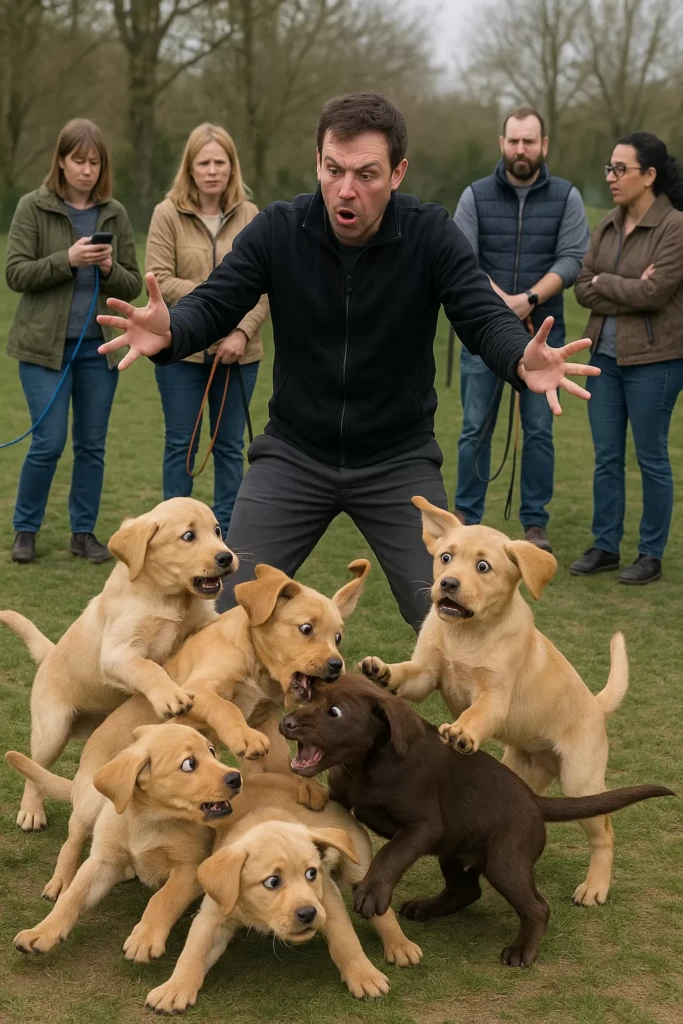
Few practices in early dog development are as normalized—and as harmful—as puppy groups.
They are promoted as socialization.
They are justified as necessary.
They are defended with the claim that dogs need dogs.
This claim is false.
And the damage caused by acting on it is profound.
Dogs Do Not Need Dogs
Domesticated dogs do not form their primary attachment bonds with other dogs. They form them with humans.
This has been demonstrated repeatedly in attachment research, including the work of Ádám Miklósi and others. Dogs use humans as a secure base in much the same structural way human children orient toward their parents.
Under stress, dogs:
- seek proximity to humans
- regulate through human presence
- show separation distress toward humans, not conspecifics
- orient to humans for safety and decision-making
Stable, deep dog–dog attachment bonds within a household are rare.
When they do occur, they are most often found where the human–dog attachment is insecure or unreliable.
In simple terms:
Dogs turn to other dogs when humans fail to function as attachment figures.
That is compensation—not a developmental need.
The Myth That Fuels Puppy Groups
The idea that dogs need early, intensive contact with other dogs has led to a cascade of harmful practices:
- forced puppy play sessions
- early group exposure
- social pressure framed as learning
- deliberate non-intervention by humans
All of this is justified as “teaching social skills.”
What it actually teaches is something else.
What Puppies Learn in Puppy Groups
In puppy groups, puppies are typically:
- surrounded by unfamiliar dogs
- exposed to constant social signaling
- expected to self-regulate far beyond their capacity
- prevented from retreating
- observed instead of protected by their humans
From a developmental perspective, this creates a fatal inversion.
Instead of learning:
My human keeps me safe.
the puppy learns:
When things become overwhelming, I am on my own.
This is not social learning.
It is attachment erosion.
Stress Does Not Create Social Competence
A puppy under social stress does not learn communication or boundaries. It learns survival strategies.
These include:
- appeasement
- emotional suppression
- hypervigilance
- shutdown or dissociation
Some puppies become loud and frantic.
Others become quiet and compliant.
Both are often misread as successful socialization.
They are not.
They are adaptive responses to unmanaged stress.
The Silent Damage
The most dangerous aspect of puppy groups is that many puppies do not visibly collapse.
They continue to function.
They continue to play.
They continue to obey.
But the relational message has already been internalized:
My signals do not lead to protection.
This damage rarely shows immediately.
It surfaces later as:
- emotional distance from humans
- excessive dependence or avoidance
- reactivity toward other dogs
- sudden aggression “out of nowhere”
- depressive or flat affect
- loss of trust under pressure
At that point, the early cause is forgotten.
The dog is blamed.
Training resumes.
Or the dog is replaced.
The Core Developmental Error
Puppy groups are built on the wrong priority.
Early development is not about social competence.
It is about secure attachment.
Only a puppy that feels protected, regulated, and oriented toward its human caregiver can later navigate social complexity without losing itself.
Dog–dog interaction is not foundational.
It is optional, situational, and secondary.
The Hard Line
There is nothing a puppy group can provide that cannot be learned later under safer conditions.
There is much it can destroy that is extremely difficult to repair.
If a practice:
- undermines human–dog attachment
- ignores developmental limits
- silences communication
- and normalizes overwhelm
then it is not education.
It is harm—normalized, systematized, and defended by myth.
This is an excerpt from our studies to become a Relational Neuroethologist.

