
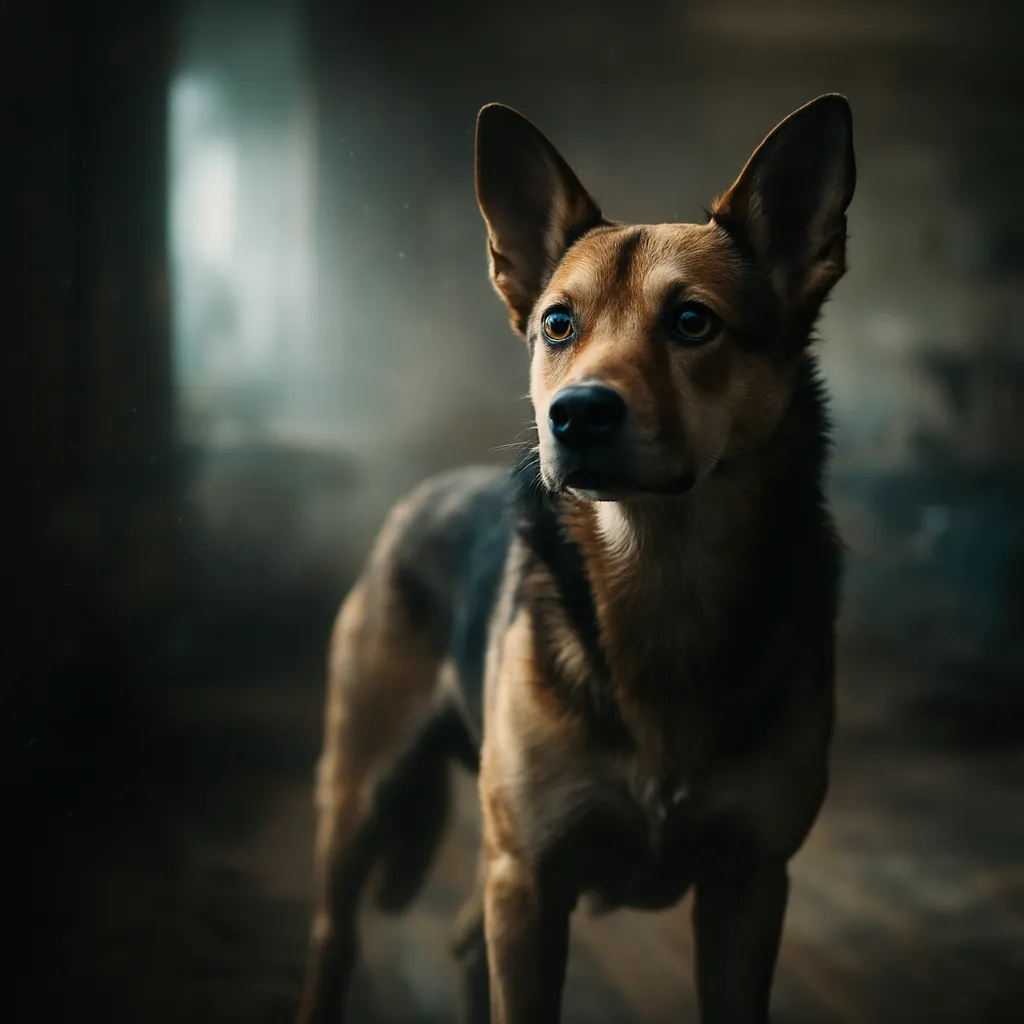
Why is your dog anxious? Not because he’s “sensitive,” disobedient, or undertrained — but because his nervous system is stuck in survival mode. In this article, we break down what canine anxiety really is, how it develops, and why training and antidepressants only make it worse. If you want to understand fear instead of fighting it, start here.
Why Your Dog Isn’t “Nervous” — His Nervous System Is Tired of Surviving
Most people think a dog with anxiety is “shy,” “reactive,” or “in need of confidence training.”
Translation: They have no clue what’s actually happening.
Anxiety in dogs isn’t a mood.
It isn’t a personality trait.
And it sure as hell isn’t a “behavior problem.”
It is a nervous system stuck in prediction mode, endlessly scanning the world for danger because once — or many times — danger was real.
Let’s break it down without fairy tales or feel-good dog training slogans.
What Anxiety Really Is
Anxiety is the anticipation of threat when nothing dangerous is actually happening.
In neurobiology terms, it means:
- The sympathetic system is firing too often
- Parasympathetic safety states are inaccessible
- Neuroception (“Is it safe?”) is stuck on red alert
- The dog’s internal world is louder than the external one
It’s a full-body survival pattern —
not a character flaw.
How Anxiety Develops
Not by “lack of leadership.”
Not because the dog “was spoiled.”
And not because the dog “needs confidence building.”
Anxiety disorders develop when:
- The dog experiences threats or overwhelm it cannot escape
- The nervous system encodes the world as unpredictable
- Safety cues become rare or absent
- Stress accumulates faster than the dog can regulate
- Humans misread early signs and add more stress (training, pressure, exposure)
The uncomfortable truth:
Training makes anxiety worse every single time
because it teaches the dog to override internal signals… which increases internal chaos.
What Anxiety Looks Like (the real version, not the TV-trainer version)
- Hypervigilance
- Startle responses
- Barking at “nothing”
- Difficulty resting
- Pacing
- Being unable to eat outside
- Freezing when overwhelmed
- Constant scanning
- Sudden shutdown
- Seemingly irrational fears
- Over-attachment or avoidance
This is not misbehavior.
It is survival intelligence doing overtime.
What NEVER Helps
Let’s get this out of the way:
- Obedience training
- Counterconditioning
- Exposure/flooding
- “He just needs confidence” routines
- Ignoring
- Overstimulating environments
- Dominance frameworks
- Reward-based pressure to perform calmness
If it sounds like work, effort, or compliance → it will fail.
Why?
Because the dog is not misbehaving —
the dog is overwhelmed.
Behavioral tricks can’t fix a dysregulated nervous system.
Ever.
What Actually Helps
The only thing that heals anxiety is regulation, not performance.
- Physiological safety (predictability, calm humans, gentle routines)
- Co-regulation (a stable human nervous system the dog can borrow stability from)
- Somatic communication (slower movement, softer orientation, grounded presence)
- Reducing sensory overload
- Supporting choice and agency
- Rebuilding familiarity and rhythm
An anxious dog doesn’t need to be trained.
He needs to feel safe enough to stop surviving.
Conclusion
Anxiety isn’t a behavior problem.
It’s a state problem.
You can’t train a dog out of survival mode.
You can’t command a nervous system into safety.
And antidepressants?
Antidepressants won’t fix an anxious dog — they only mute the symptoms while the nervous system keeps drowning underneath.
This is why Relational Neuroethology works — and why training and medication never do.

