
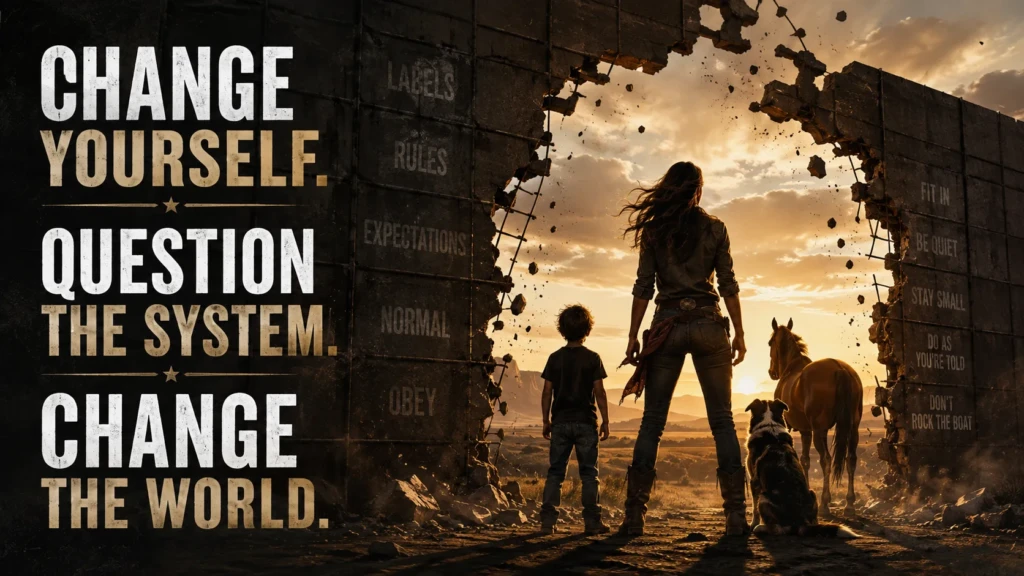
The System Ain’t Always Right
Every now and then, somebody says:
“We ought to make the world a better place.”
And right on cue, the chorus starts.
“Can’t be done.”
“Nobody listens.”
“People don’t change.”
“That’s just how things are.”
Well, hell.
That’s convenient.
Build a broken system, shrug at it long enough, and eventually everybody starts treating it like weather.
As if nobody made it.
As if nobody benefits from it.
As if nobody could tear the damn thing apart and build something better.
Here’s the problem:
We’ve built systems that decide what a person, a child, or an animal is supposed to look like.
And if the individual doesn’t fit?
We rarely question the system.
We question the individual.
Fit In or Get Labeled
A child goes to school.
Now the rules begin.
Sit still.
Pay attention.
Speak when allowed.
Learn at the right speed.
Learn in the right way.
Make friends with the people nearby.
Take part.
Behave appropriately.
Blend in.
My daughter was seven when I got called into school because she spent recess by herself.
Apparently, that was a problem.
She had friends.
Plenty of them.
They just happened to be at other schools.
Her explanation was simple:
“I choose my own people.”
She was seven.
That wasn’t social incompetence.
That was social selection.
But systems don’t like selection unless they’re the ones doing it.
So instead of asking:
“Is she actually unhappy?”
or:
“Does she have meaningful relationships somewhere else?”
the question becomes:
“Why isn’t she doing what everybody else is doing?”
And there it is.
The first little crack.
Not:
“Does this person function well?”
But:
“Does this person function the way we expect?”
Those are not the same thing.
Not even close.
We Love Individuality — Until It Gets Inconvenient
Everybody loves individuality.
Schools advertise it.
Companies print it on posters.
Parents brag about it.
Dog trainers talk about “the individual dog.”
Politicians put it in speeches.
Sounds wonderful.
Right up until somebody is actually different.
Too loud.
Too quiet.
Too fast.
Too slow.
Too sensitive.
Too independent.
Too intense.
Not social enough.
Too social.
Needs more movement.
Needs more space.
Needs less bullshit.
That last one tends to cause trouble.
Because real individuality is messy.
It doesn’t line up nicely.
It doesn’t always sit still.
It doesn’t always obey.
It doesn’t always smile politely while somebody else decides what’s best.
And systems hate that.
Systems like predictable.
Predictable is easy to manage.
Easy to manage gets called “well adjusted.”
And anything outside that box gets a closer look.
Then a label.
Then, if possible, a correction plan.
Sometimes the Individual Isn’t Broken
Take a child diagnosed with ADHD.
Put that child in a rigid setting and maybe the child becomes “the problem.”
Can’t sit still.
Can’t stay in line.
Too much energy.
Too distracted.
Too impulsive.
Now change the environment.
Change the task.
Give that same kid a role where energy, speed, creativity, movement, and unpredictability are useful.
Funny thing happens.
What looked like dysfunction can suddenly look a whole lot like ability.
I once had a girl like that in a riding group.
She couldn’t stay in formation.
So I stopped trying to force her into formation.
I made her the one whose job was to disrupt it.
Suddenly she wasn’t failing.
She was succeeding at something nobody else in the group could do quite like her.
And later?
She could ride in formation too.
We didn’t beat the difference out of her.
We gave it somewhere useful to go.
That matters.
Blind Doesn’t Mean Incapable
I once worked with a boy who had been blind since birth.
He loved horses.
His parents thought maybe he could pet them now and then.
Ride?
That seemed impossible.
After all, he couldn’t see.
Except the horse could.
So he learned.
A few months later, we rode out together.
One horse each.
His blindness was real.
The limitation everybody built around it wasn’t.
That part came from people.
And we do that constantly.
We see one difference and build ten assumptions around it.
Then we call the assumptions reality.
Dogs Get an Even Worse Deal
Dogs don’t get a vote.
Not one.
We decide where they live.
When they eat.
When they sleep.
When they walk.
How long they’re alone.
How much noise they endure.
Who touches them.
Who visits.
What dogs they’re supposed to like.
How calm they’re supposed to be.
How social.
How obedient.
How focused.
How independent.
How affectionate.
How much eye contact they should make.
How fast they should respond.
How much freedom is too much freedom.
Then we watch them inside this completely human-designed environment and say:
“This dog has a problem.”
Maybe.
Or maybe the dog is reacting perfectly normally to a stupid setup.
That possibility seems to hurt people’s feelings.
So instead we get labels.
Reactive.
Dominant.
Hyperactive.
Aggressive.
Anxious.
Obsessive.
Difficult.
Untrainable.
Dangerous.
We build the fence.
We control the food.
We control the movement.
We control the social world.
We control the body.
We control the choices.
And then we diagnose the behavior inside the cage.
That’s one hell of a neat trick.
The System Is Never the Patient
Here’s what systems are very good at:
Avoiding responsibility.
A school can’t feel ashamed.
An institution can’t get diagnosed.
A training culture doesn’t sit in therapy.
A political structure doesn’t lose sleep.
A family pattern doesn’t take medication.
The individual does.
So whenever something goes wrong, guess who gets examined first?
The child.
The dog.
The employee.
The student.
The outsider.
The one who refuses to cooperate.
Meanwhile, the system sits there like a fat old bull in the shade.
Untouched.
Obedience Is Not Health
Somewhere along the way, we started confusing compliance with wellness.
Quiet child?
Good child.
Obedient dog?
Good dog.
Employee who never complains?
Reliable.
Citizen who doesn’t make trouble?
Reasonable.
That is nonsense.
An individual can function beautifully inside a bad system and be miserable.
Another can reject that same system and be perfectly sane.
Sometimes the person causing trouble is not the problem.
Sometimes they’re the only one in the room awake.
“But You Can’t Change the World”
Sure you can.
People change it every damn day.
They change laws.
They change schools.
They change workplaces.
They change medicine.
They change parenting.
They change what society accepts.
They change how animals are treated.
They change language.
They change rights.
They change expectations.
Most of what people call “normal” today would have looked insane, immoral, or impossible a few generations ago.
So no, “it can’t be changed” isn’t an argument.
Neither is:
“Nobody will listen.”
Somebody always listens eventually.
And “What can one person do?” is usually just fear wearing respectable clothes.
Every major shift starts somewhere.
Usually with somebody saying:
“This is bullshit.”
Maybe We’re Asking the Wrong Question
Maybe the question shouldn’t be:
“How do we make this child fit school?”
Maybe it should be:
“How do we build a school that can handle different kinds of children?”
Maybe the question shouldn’t be:
“How do we make this dog fit our lifestyle?”
Maybe it should be:
“What kind of life allows this dog to function well?”
Maybe the question shouldn’t be:
“How do we make people behave properly?”
Maybe it should be:
“Who decided what ‘properly’ means?”
And maybe the quality of a system shouldn’t be measured by how efficiently it produces conformity.
Maybe it should be measured by how many different individuals can live inside it without having to cut pieces off themselves just to fit.
That applies to kids.
Adults.
Old people.
Disabled people.
People who think differently.
Dogs.
Horses.
Pretty much every living creature we drag into structures we created ourselves.
So here’s a radical idea:
Next time somebody doesn’t fit, don’t immediately ask:
“What’s wrong with you?”
Ask:
“What the hell is wrong with the system?”
And if your answer is:
“Nothing can be changed.”
Congratulations.
You just became part of it.

