

Why Secure Bonding Is Not Closeness – but Development
Attachment theory is everywhere.
In psychology. In parenting. In dog behavior. In therapy.
Everyone talks about bonding – and yet, people keep misunderstanding each other.
Some believe attachment means closeness.
Others think distance threatens bonding.
And many assume that if independence appears, attachment must be weak.
All of this is based on a single, persistent mistake:
attachment is treated as a state, not as a developmental process.
What attachment theory actually describes
Classical attachment theory, as developed by John Bowlby, focuses on early developmental phases.
It describes:
- immature nervous systems,
- dependence on external regulation,
- and the need for reliable caregivers to ensure survival.
This framework is valid.
But it is incomplete when applied beyond early dependency.
Attachment theory explains how security is established.
It does not fully explain how security is completed.
The category error nobody talks about
In dogs – and often in humans – attachment theory is applied as if the dependent phase were permanent.
Dogs are treated like perpetual toddlers.
Adults are treated as if autonomy were a threat to bonding.
Distance is interpreted as avoidance.
Exploration is mistaken for detachment.
This is a category error.
Dogs are not infants.
Adult humans are not infants.
And secure attachment is not meant to freeze development at the point of need.
What ethology adds to the picture
Ethological research, particularly the work of Ádám Miklósi, shows something crucial:
When attachment is secure, exploration increases.
Not decreases.
The caregiver or reference person becomes:
- a background anchor,
- a point of orientation,
- not a constant regulator.
In other words:
successful attachment reduces dependence.
The missing link: attachment as a developmental movement
Attachment does not end with security.
It moves through security.
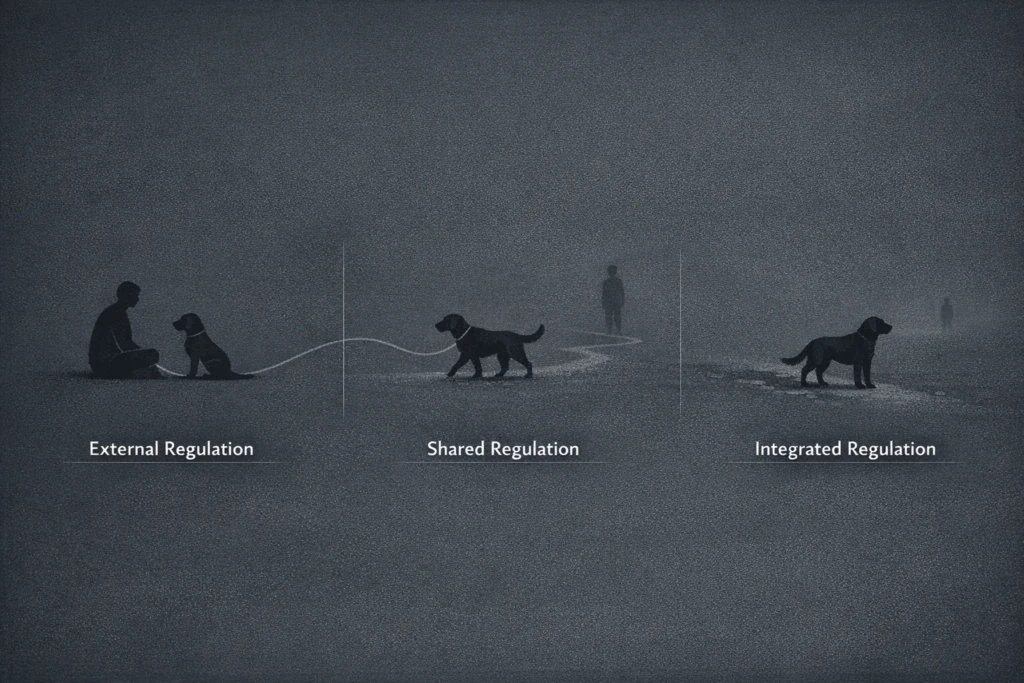
A complete attachment process unfolds in phases:
- External regulation
High dependency is normal. Responsiveness is necessary. - Shared regulation
The relationship becomes a reference, not a lifeline. - Integrated regulation
Autonomy becomes possible without relational threat.
This third phase is rarely recognized as attachment at all.
It is labeled independence – as if attachment had disappeared.
It has not.
It has been internalized.
Why “bonding equals freedom” is not a contradiction
The idea that bonding enables freedom sounds paradoxical only if attachment is defined by proximity.
Secure bonding does not hold on.
It holds in place.
A securely bonded individual can:
- move away without emotional punishment,
- explore without losing connection,
- return without conditions or appeasement.
This is not detachment.
It is mature attachment.
What goes wrong when development stops
When attachment is not allowed to evolve:
- dependence is mistaken for closeness,
- constant orientation replaces exploration,
- and emotional over-adaptation is praised as loyalty.
This does not create security.
It creates fixation.
In dogs, this shows up as chronic hyper-orientation and loss of self-agency.
In humans, it appears as relational anxiety masked as intimacy.
The cost of misunderstanding attachment
When attachment is reduced to closeness:
- autonomy is pathologized,
- distance is moralized,
- and development is quietly blocked.
Relationships become tight instead of stable.
Regulation becomes control.
Love becomes pressure.
The central distinction
There is no wellbeing without bonding.
But bonding is not dependence.
Bonding is what makes independence possible.
Attachment is not proven by staying close.
It is proven by being able to leave without losing the relationship.
A final thought
Attachment theory does not need to be replaced.
It needs to be finished.
Its missing link is development beyond dependency.
Without it, attachment remains incomplete –
and freedom keeps being misunderstood as loss.

