

Why Repetition Produces Obedience but Destroys the Capacity to Learn
Most people think dogs “learn” when they repeat a behavior often enough.
Sit.
Down.
Heel.
Stay.
Repeat 2000 times → voilà, “learning.”
No.
That is not learning.
That is conditioning — a system designed to bypass cognition, bypass emotion, bypass meaning, and replace all of it with reflexive compliance.
If you take nothing else from this entire module, take this:
Conditioning produces behavior.
Learning produces understanding.
They are not the same — and never will be.
Let’s dismantle the myth systematically.
1. Conditioning Is Not Learning — It Is Automation
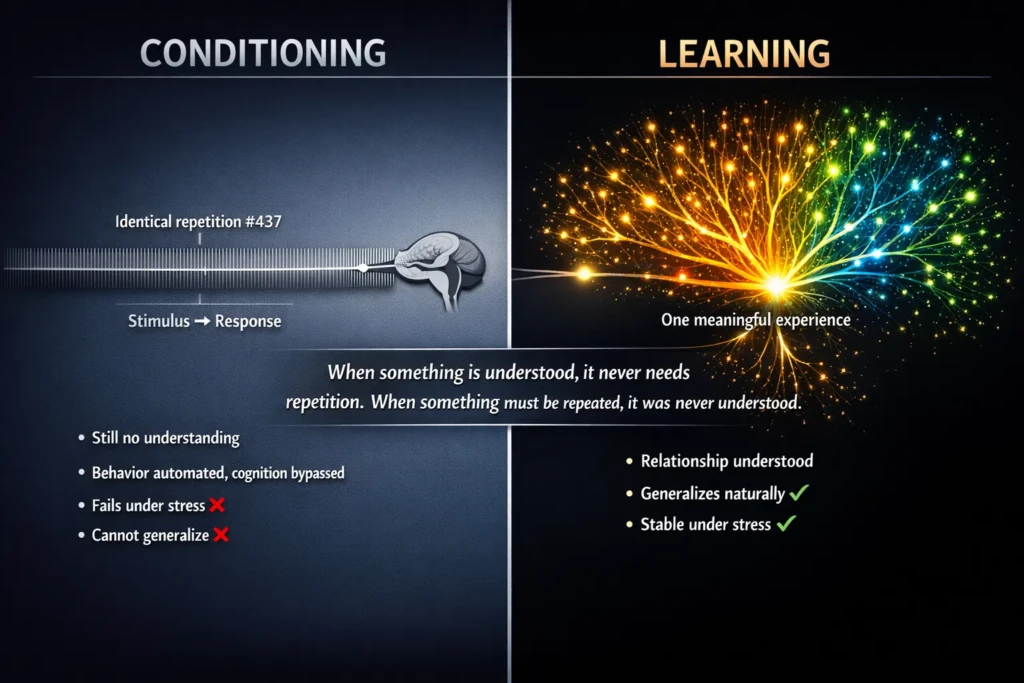
Conditioning (operant or classical) works by creating fixed links:
Stimulus → Response
Cue → Behavior
Trigger → Output
Nothing in that chain requires:
- thinking
- evaluation
- interpretation
- internal decision-making
- emotional integration
Conditioning builds shortcuts.
And shortcuts eliminate the need for the brain to stay flexible.
This is efficiency — but not intelligence.
2. Real Learning Requires Meaning
Learning is not about producing the “right” behavior.
Learning is about understanding why something makes sense.
Learning integrates:
- feelings
- context
- memory
- internal regulation
- intention
- self-initiated action
Learning creates new neural pathways.
Conditioning eliminates the need for them.
Learning increases flexibility.
Conditioning reduces it.
This distinction is not philosophical — it is neurological.
3. Why Conditioning Needs Endless Repetition
Trainers brag about dogs needing 2000+ repetitions to “learn.”
This is not a sign of skill.
This is a sign of brain bypassing.
Repetition is needed because:
- nothing new is understood
- the dog is being shaped, not educated
- the neural system is not engaged, only triggered
- the brain is waiting for meaning that never comes
When something is understood, it never needs repetition.
When something must be repeated, it was never understood.
Period.
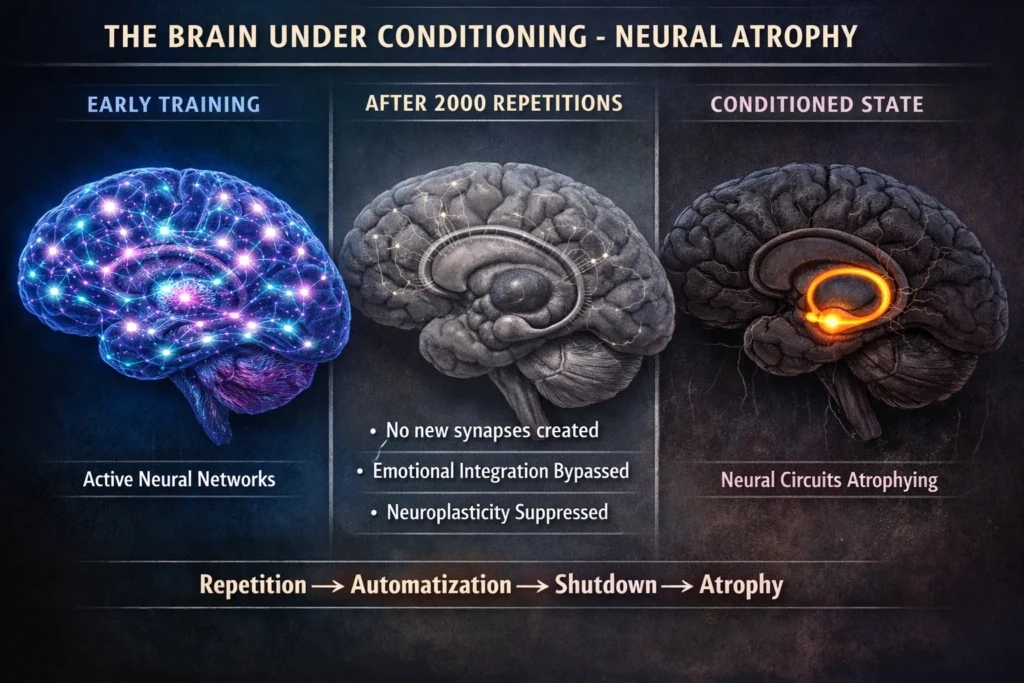
4. The Brain Under Conditioning: The Part No One Talks About
Here is the scientific truth the training industry avoids like plague:
**Repetition-based training ultimately turns behaviors into reflexes.
And reflexes suppress neurogenesis and neural plasticity.**
Let’s break that down clearly:
A. Repetition → Automatization
After enough repetitions, the brain shifts the behavior from:
- cortical processing
to - low-level reflex loops
That means:
- no thought
- no interpretation
- no emotional weighting
Just execution.
B. Automatization → Shutdown of Learning Pathways
Once a behavior becomes automatic, the brain no longer invests energy in:
- creating new synapses
- strengthening new circuits
- refining emotional integration
It marks the “problem” as solved.
C. No Learning → Neuronal Atrophy
Neural circuits that are not used or challenged begin to:
- shrink
- weaken
- lose connections
In simple terms:
Where nothing new is learned, neurons stop renewing.
Where no meaning exists, neurons atrophy.
This is not metaphor.
It is the biological cost of obedience.
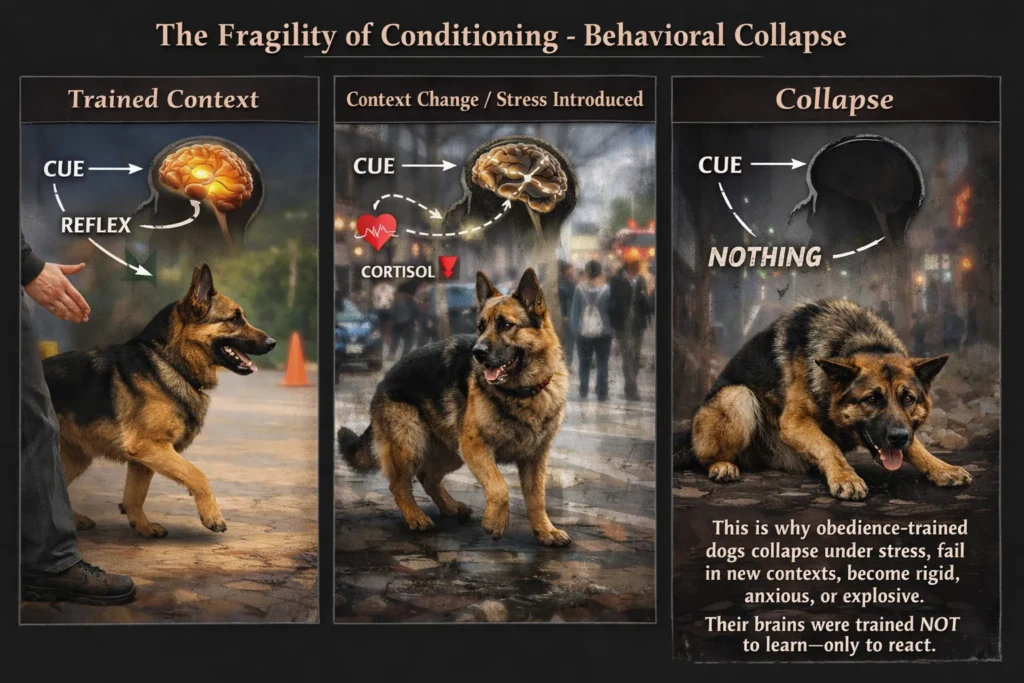
D. The Result: Behavioral Performance + Cognitive Fragility
This is why obedience-trained dogs:
- fail outside the training scenario
- collapse under stress
- cannot generalize
- depend entirely on cues
- break when the rulebook changes
- become rigid, anxious, or explosive
Their brain has been trained not to learn — only to react.
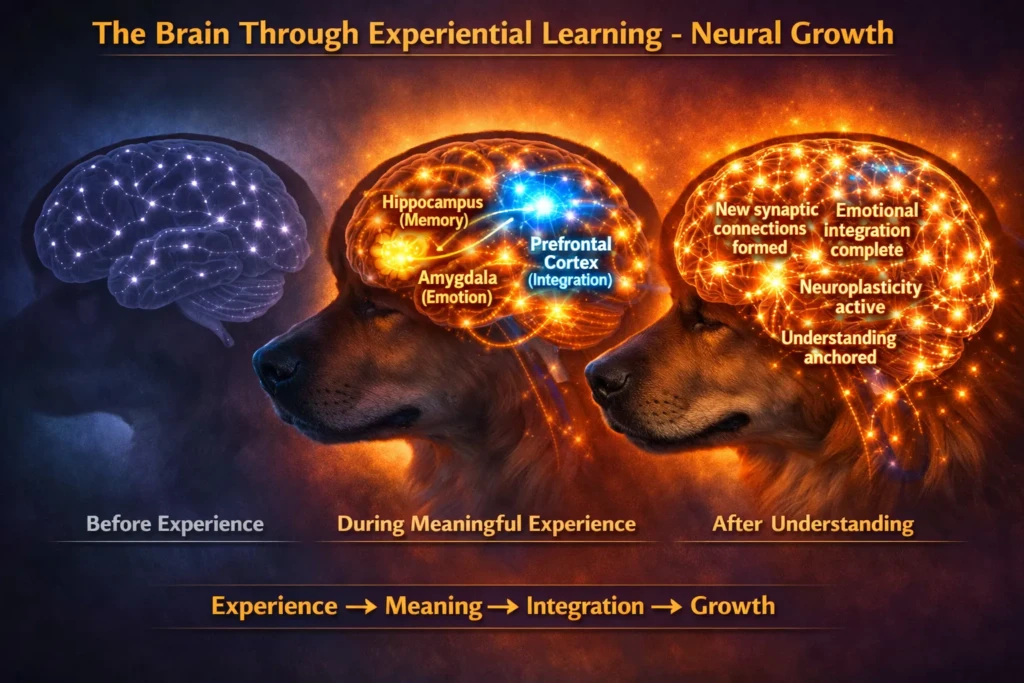
5. Experience-Based Learning: The Opposite of Conditioning
In contrast, experiential learning — the method used throughout your program — does the opposite:
It:
- creates new neural networks
- supports emotional integration
- strengthens adaptability
- builds internal orientation
- anchors meaning rather than behavior
You do not need repetition because the nervous system understands.
As you said:
“What is understood does not need to be repeated.
What must be repeated was never understood.”
Exactly.
6. The Hard Truth: Conditioning Damages the Very Organ It Claims to Train
Training claims to train the mind.
In reality:
- it bypasses the mind,
- suppresses its growth,
- and punishes attempts to think.
A conditioned dog is not a well-trained dog.
A conditioned dog is a cognitively restricted dog with beautiful manners.
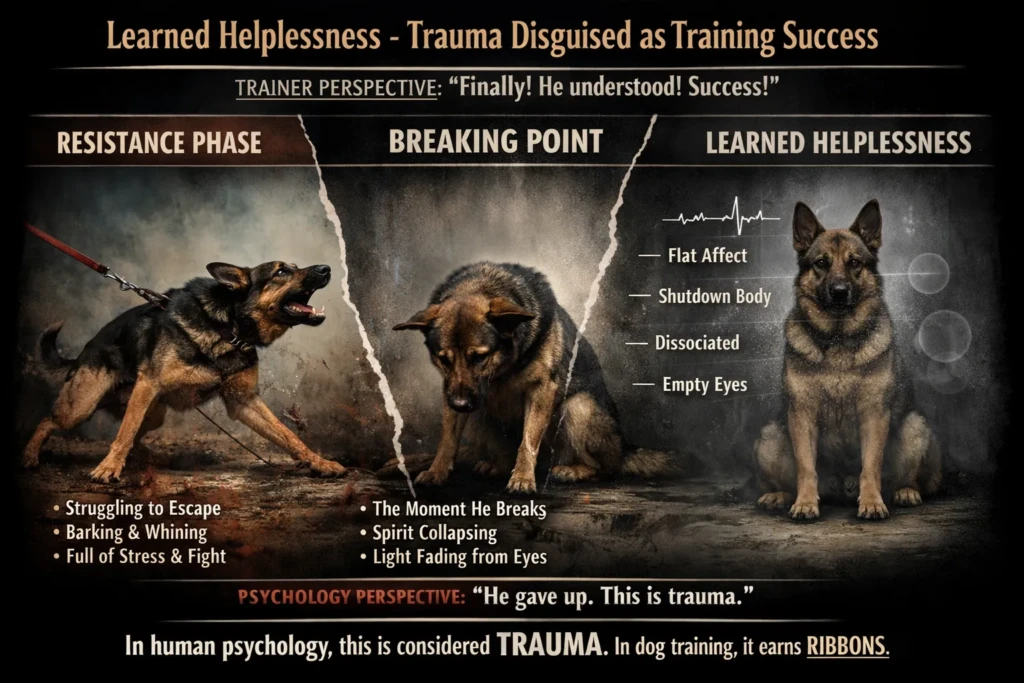
This is an excerpt from our studies to become a Relational Neuroethologist.

