
Why real inhibition emerges from safety, not obedience — and why forced “impulse control” destroys the very system it tries to build.
This is an excerpt from our studies to become a Relational Neuroethologist.
1. What Inhibition Actually Is
Inhibition is the brain’s voluntary decision to withhold an impulse
because another action is predicted to produce a better outcome.
Key points:
- It is internal, not externally imposed.
- It requires a functioning prefrontal cortex.
- It depends on emotional regulation, not willpower.
- It increases with safety, predictability, and attachment stability.
- It collapses under stress, fear, or pressure.
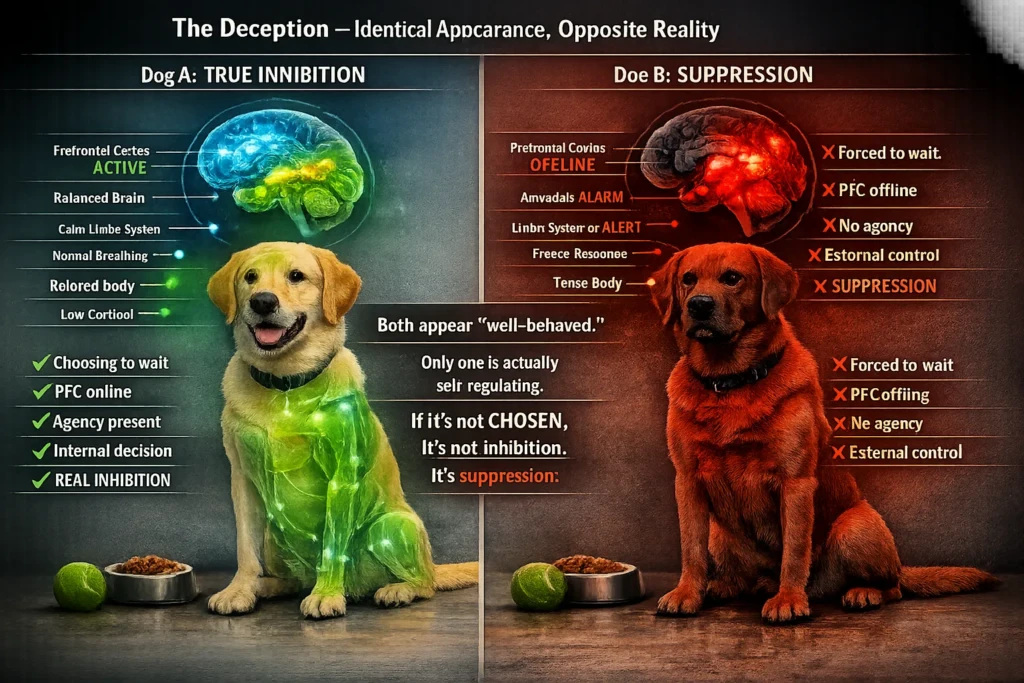
If it’s not chosen,
it’s not inhibition.
It’s suppression.
2. The Neurobiology of Inhibition
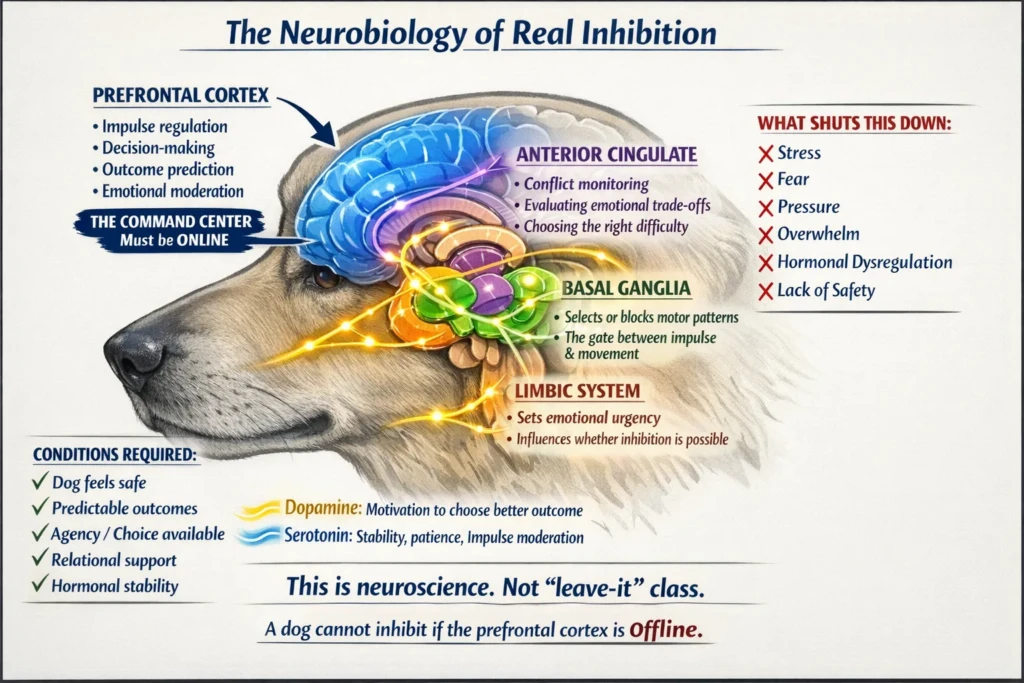
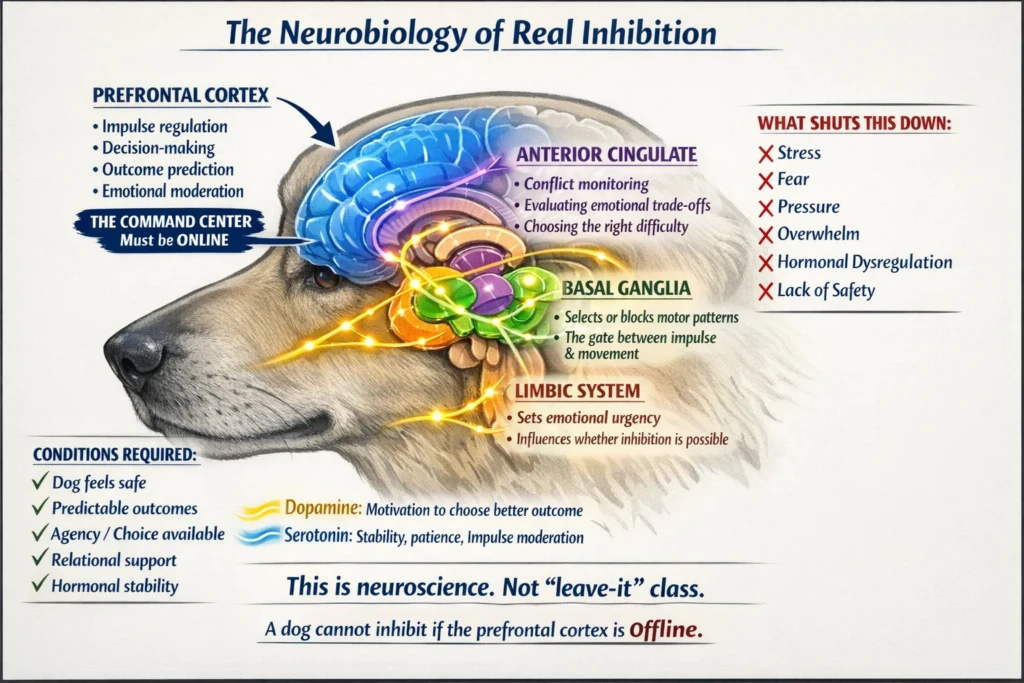
Real inhibition is a coordinated effort of:
Prefrontal Cortex (PFC)
- impulse regulation
- decision-making
- outcome prediction
- emotional moderation
A dog cannot inhibit if:
- he’s stressed,
- the PFC is offline,
- hormones are dysregulated,
- he’s unsafe,
- he’s overwhelmed.
Basal Ganglia
- selects or blocks motor patterns
- the “gate” between impulse and movement
Anterior Cingulate Cortex
- conflict monitoring
- evaluating emotional trade-offs
- choosing the “right difficulty”
Limbic System
- sets emotional urgency
- influences whether inhibition is even possible
Dopamine & Serotonin
- dopamine = motivation to choose a better outcome
- serotonin = stability, patience, impulse moderation
Wolf comment:
This is neuroscience. Not “leave-it” class.
3. What Inhibition is NOT
A dog sitting still because:
- he fears correction,
- he expects pressure,
- he avoids disappointing the human,
- he shuts down under stress,
- he freezes due to limbic overload,
- he’s learned helplessness,
…is not inhibiting an impulse.
He is avoiding a threat or dissociating.
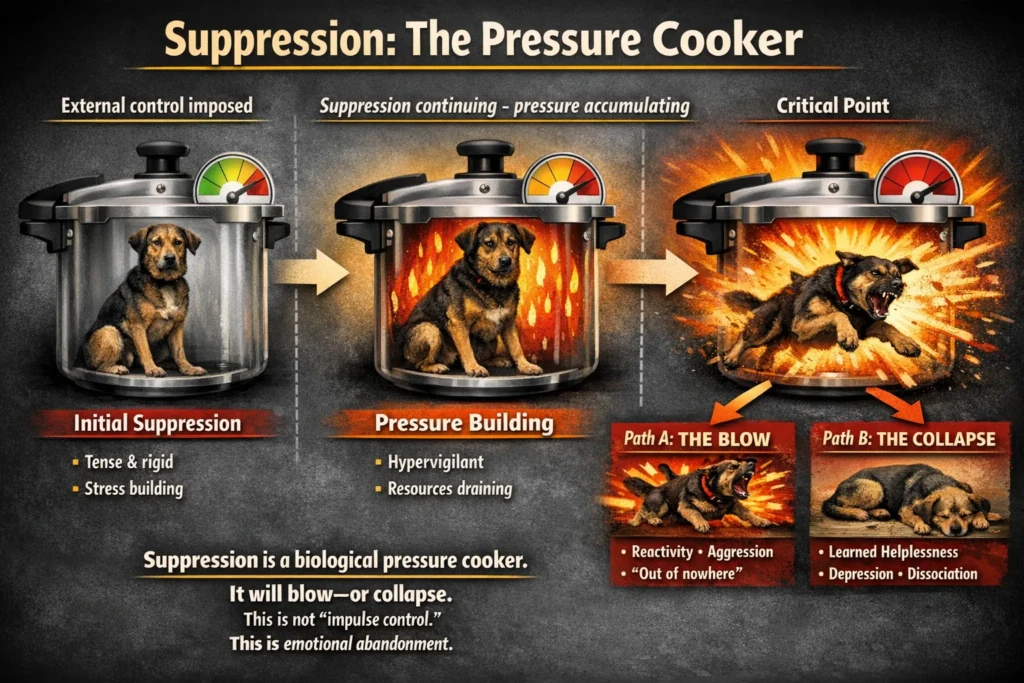
This is not self-control.
This is emotional abandonment.
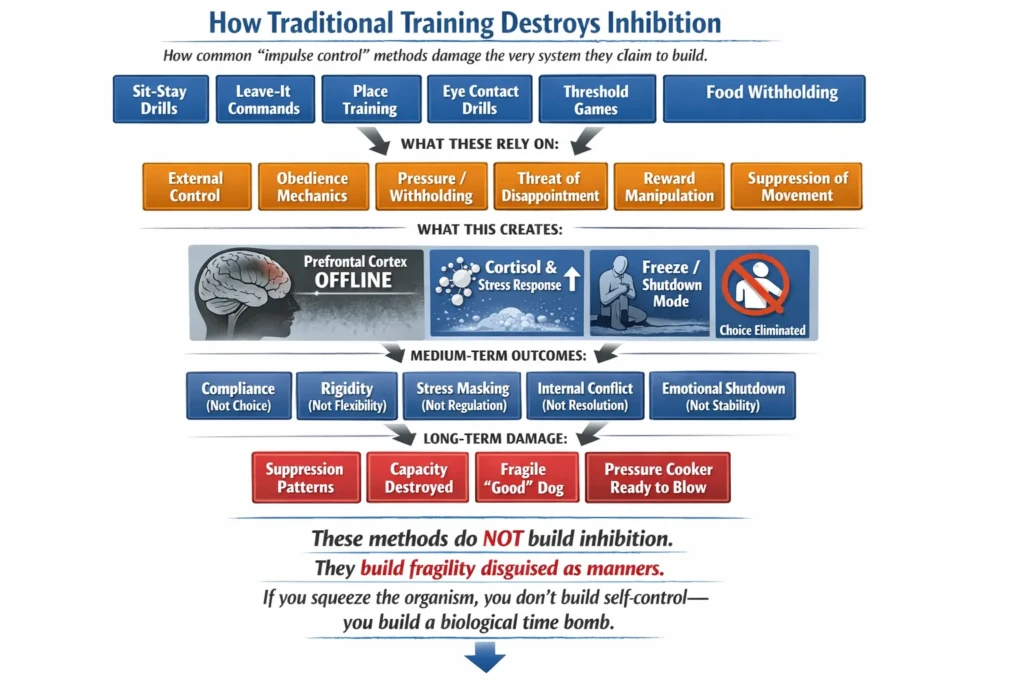
4. Why Traditional “Impulse Control Training” Fails
Most “impulse control exercises” (sit-stay, place training, eye contact drills, leave-it, threshold games) rely on:
- external control
- obedience mechanics
- pressure or withholding
- threatening disappointment
- reward manipulation
- suppression of movement
These do NOT build inhibition.
They build:
- compliance,
- rigidity,
- stress masking,
- conflict,
- and, in many dogs, shutdown.
True inhibition requires:
- autonomy
- safety
- agency
- emotional space
- internal motivation
Not cues.
Not protocols.
Not handler control.
Wolf comment:
If you squeeze the organism, you don’t build self-control — you build fragility disguised as manners.
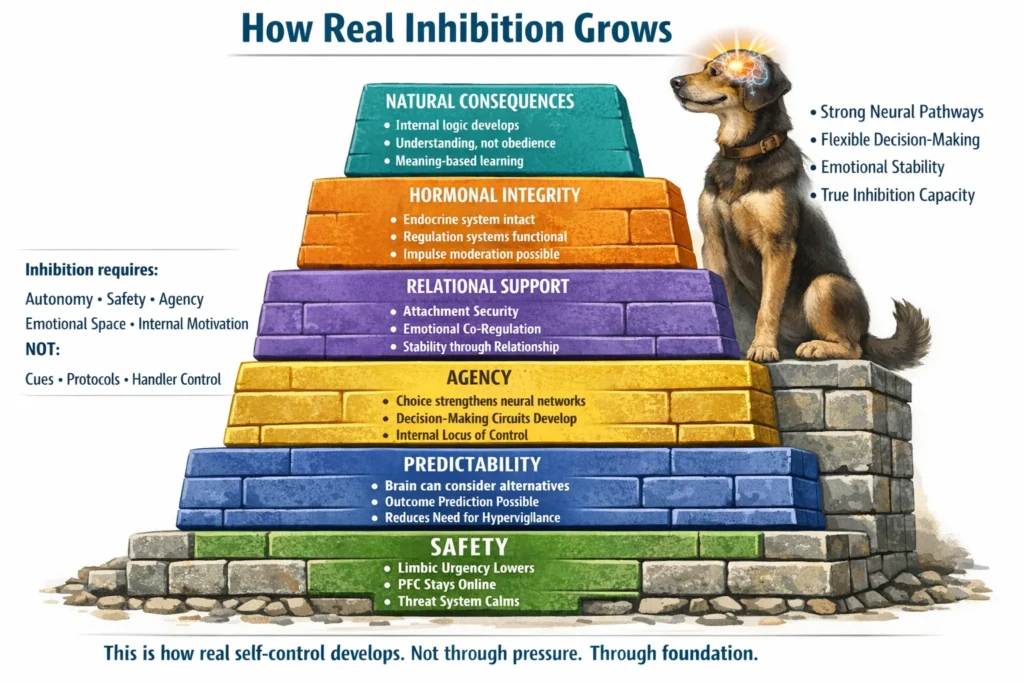
5. How Real Inhibition Develops
Inhibition grows when:
A. The dog feels safe.
Safety lowers limbic urgency → the PFC stays online.
B. The dog has predictable outcomes.
Predictability allows the brain to consider alternatives.
C. The dog has agency.
Choice strengthens neural networks of decision-making.
D. The dog experiences relational support.
Attachment security stabilizes emotional responses.
E. The dog’s hormonal system is intact.
Endocrine stability supports impulse regulation
(yes, neuter often destroys inhibition capacity).
F. The dog learns through natural consequences, not external pressure.
Internal logic > external obedience.
6. Signs of Real Inhibition
- choosing to wait
- pausing before acting
- adjusting intensity
- offering alternatives
- showing frustration tolerance
- walking away instead of escalating
- reducing arousal through self-chosen behavior
This is self-control, not human control.
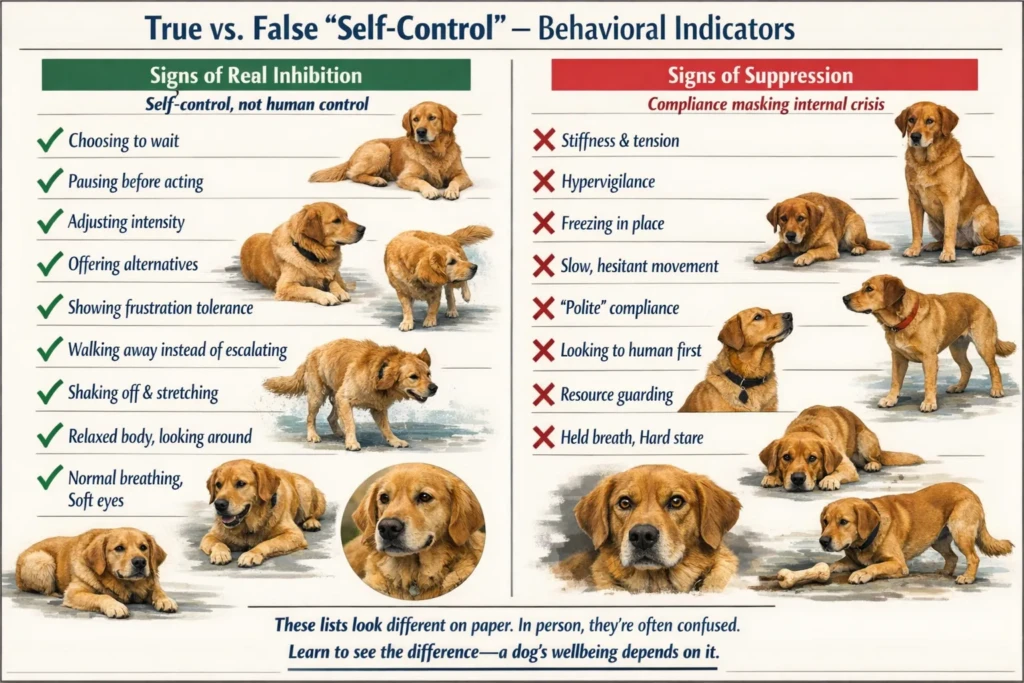
7. Signs of Suppression (Often Misinterpreted as “Good Behavior”)
- stiffness
- hypervigilance
- freezing
- slow, hesitant movement
- “polite” compliance
- looking to the human before acting
- lack of initiative
- loss of exploration
- tension around food or toys
- small tail movements masking internal strain
Suppression is a biological pressure cooker.
It will blow — or collapse.
8. Clinical Application: Working WITH Inhibition, Not Against It
Before you call something “impulse control,”
ask:
- Is the dog safe?
- Is the dog choosing?
- Are alternatives available?
- Can the dog influence the situation?
- Is the prefrontal cortex online?
- Is movement allowed?
- Is the dog emotionally stable enough to inhibit?
If the answer is “no,”
then the organism is not inhibiting —
it is surviving.
Comment:
A dog cannot regulate what he cannot control.

