
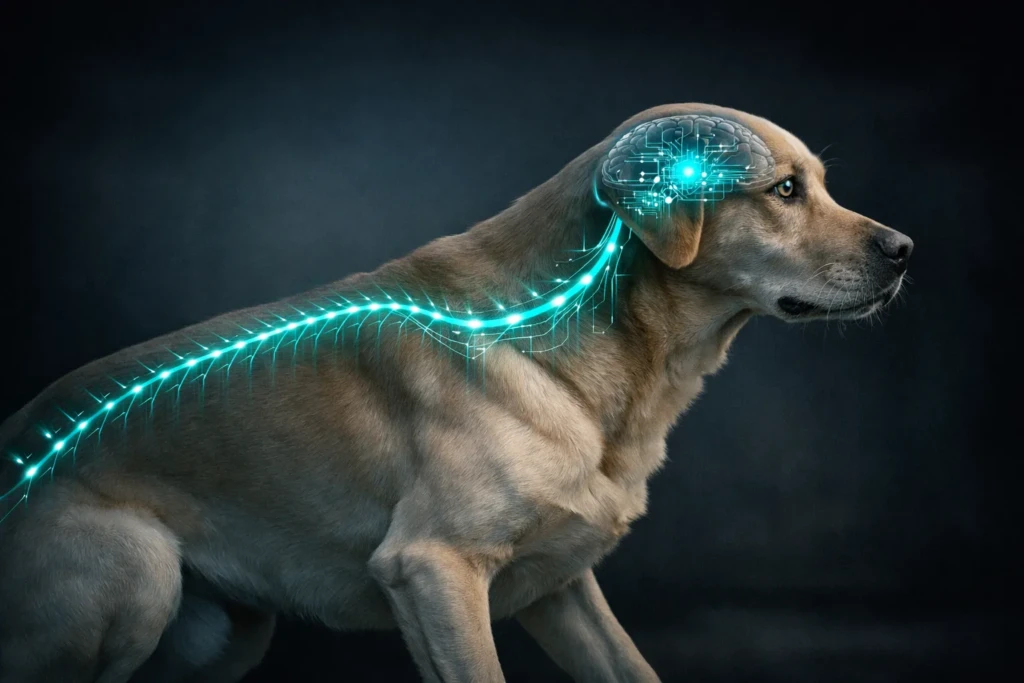
Trauma isn’t the event itself — it’s the nervous system getting stuck in survival mode long after the danger is gone.
This article breaks down what really happens inside a dog’s brain and body when trauma forms: how neuroception fails, why the prefrontal cortex shuts down, how the amygdala takes over, and why traumatized dogs cannot “behave better” no matter how much training you throw at them.
If you’ve ever wondered why a dog reacts, shuts down, or panics with no obvious cause, start here.
What Trauma Actually Is
(and what happens in the brain and nervous system when a dog “breaks”)**
Relational Neuroethology Trauma Series – Part 1
Scientific, sharp, no sugar-coating.
Most people use the word “trauma” as if it were some dramatic event — an attack, an accident, abuse, shock.
But trauma isn’t the event.
Trauma is the state the nervous system gets stuck in afterward.
The event is just the trigger.
The trauma is what happens inside when the system can’t return to safety.
Let’s strip away the drama and get to the biological truth — the only truth that matters for dogs.
1. Trauma begins when the nervous system loses its ability to downshift
A healthy nervous system cycles through states:
- alert →
- focused →
- stressed →
- then back to calm
Trauma begins when the dog can enter stress,
but can’t get out.
It’s like pressing the gas pedal,
and the brake is gone.
The dog isn’t “reactive” or “dramatic.”
He’s locked in survival gear.
This is not psychological.
This is neurophysiology.
2. Trauma is the failure of neuroception — the brain’s safety scanner
Dogs don’t think “Am I safe?”
Their bodies feel it.
Neuroception is the built-in safety radar that constantly scans:
- Is this safe?
- Is this dangerous?
- Can I rest?
- Do I need to defend?
When trauma hits, neuroception gets corrupted.
A traumatised dog sees danger:
- where none exists,
- where it once existed,
- or anywhere unpredictability appears.
The brain isn’t choosing fear.
It’s perceiving threat where the world no longer matches the map inside.
3. Trauma shuts down the prefrontal cortex — the part trainers love so much
The prefrontal cortex handles:
- learning
- problem-solving
- impulse control
- “obedience” (if you insist on calling it that)
Under trauma?
Offline. Unavailable. Gone.
Trying to train a traumatised dog is like giving homework to someone who’s drowning.
They don’t need commands.
They need oxygen.
This is why training fails traumatised dogs 100% of the time —
the part of the brain that training relies on is neurologisch nicht erreichbar.
4. The amygdala hijacks everything
The amygdala is the brain’s alarm system.
In trauma, it becomes a dictator.
It overrides:
- play
- learning
- exploration
- rest
- trust
- curiosity
- social behavior
And replaces it with:
- hypervigilance
- startle
- panic
- avoidance
- freeze
- aggression-as-survival
The dog isn’t “misbehaving.”
He is obeying biology.
And biology wins every time.
5. Trauma fragments internal communication
The nervous system is a network — brain, gut, heart, fascia, sensory systems.
Trauma disrupts the coherence between them.
What the dog feels
no longer matches what the dog does.
That’s why traumatised dogs:
- tremble without obvious cause
- bark “out of nowhere”
- seem fine and then collapse
- cling intensely, then avoid
- flip from high arousal to shutdown
- can’t sleep deeply
- can’t rest in unfamiliar spaces
- lose appetite or gorge food
- can’t handle normal stimuli
These aren’t mood swings.
They’re nervous-system disconnections.
6. Trauma reorganizes the entire sensory world
When the nervous system is overwhelmed:
- sounds become threats
- movement becomes danger
- new objects become predators
- unfamiliar dogs become risks
- the leash becomes a trap
- distance from the human becomes unsafe
- proximity to the human becomes unsafe
- being alone becomes panic
- being with people becomes panic
Trauma distorts perception.
It doesn’t care about logic.
This is why traumatised dogs “overreact.”
They’re reacting exactly as their brain predicts they must.
7. Trauma isn’t stored as memory — it’s stored as physiology
This is the part people struggle with, so here comes the blunt version:
Trauma is not what the dog remembers. Trauma is what the dog’s body cannot forget.
It lives in:
- muscle tone
- heart rate variability
- breathing patterns
- gut microbiome
- cortisol rhythms
- startle reflex
- sleep cycles
- vagal tone
- sensory thresholds
You can’t “train away” muscle memory.
You can’t “command” a vagus nerve to regulate.
You can’t reward a dog out of limbic hijack.
That’s why behaviorism dies here.
Undramatisch.
Einfach biologisch.
8. Trauma = the collapse of the dog’s ability to return to safety
Every living being needs one core capacity:
the ability to come back down.
Trauma steals that.
A traumatised dog:
- can escalate
- can panic
- can freeze
- can shut down
…but cannot recover without external regulation from a calm, regulated human.
This is why relational work succeeds where training crashes and burns:
Training demands performance.
Trauma needs safety.
Training pushes.
Safety regulates.
Training adds stress.
Regulation removes it.
You can’t fix trauma with pressure.
You fix trauma with connection.
9. Trauma is not rare — it’s the default in modern dog life
Given:
- overstimulation
- inconsistent households
- emotionally dysregulated humans
- chaotic early life
- inherited stress over four generations
- chronic exposure to pressure
- sensory overload
- training that punishes communication
…it would be astonishing if dogs didn’t show trauma responses.
Trauma is no longer the exception.
It’s the baseline — unless someone actively protects the dog from modern chaos.
**Conclusion — Trauma is not a behavior problem.
It’s a nervous-system injury.**
And like every injury, it needs:
- stability
- predictability
- safety
- attuned humans
- low sensory load
- space
- co-regulation
Not commands.
Not obedience.
Not corrections.
Not “confidence-building.”
Not training.
Training will get its funeral later — and es wird verdient.
But for now:
If you don’t understand what trauma is, you’ll misinterpret everything the dog does. If you do understand it, you’ll stop fighting the dog and start healing the system.
A Note on PTSD in Dogs (and why it’s not what people think)
PTSD in dogs is real — but rare.
Clinically rare.
What most people call “PTSD” is:
- chronic stress load
- dysregulated neuroception
- hypervigilance
- shutdown patterns
- sensory defensiveness
- startle reactivity
- dissociation
- compulsions
These are trauma states, yes —
but they are not the medical diagnosis of PTSD.
PTSD is simply the extreme end of the same process:
the nervous system becomes unable to return to baseline
and begins to relive threat without external triggers.
Dogs can develop PTSD after:
- military or police service
- repeated extreme threat exposure
- severe early deprivation
- human violence
- catastrophic events
But here is the real point:
You don’t need PTSD to suffer like hell. Most traumatized dogs are collapsing long before they ever reach that threshold.
And just like every other trauma state:
PTSD cannot be trained out of a dog. And no antidepressant repairs a traumatized nervous system.

