Trauma isn’t rare.
It isn’t dramatic.
And it isn’t something you can train away.**
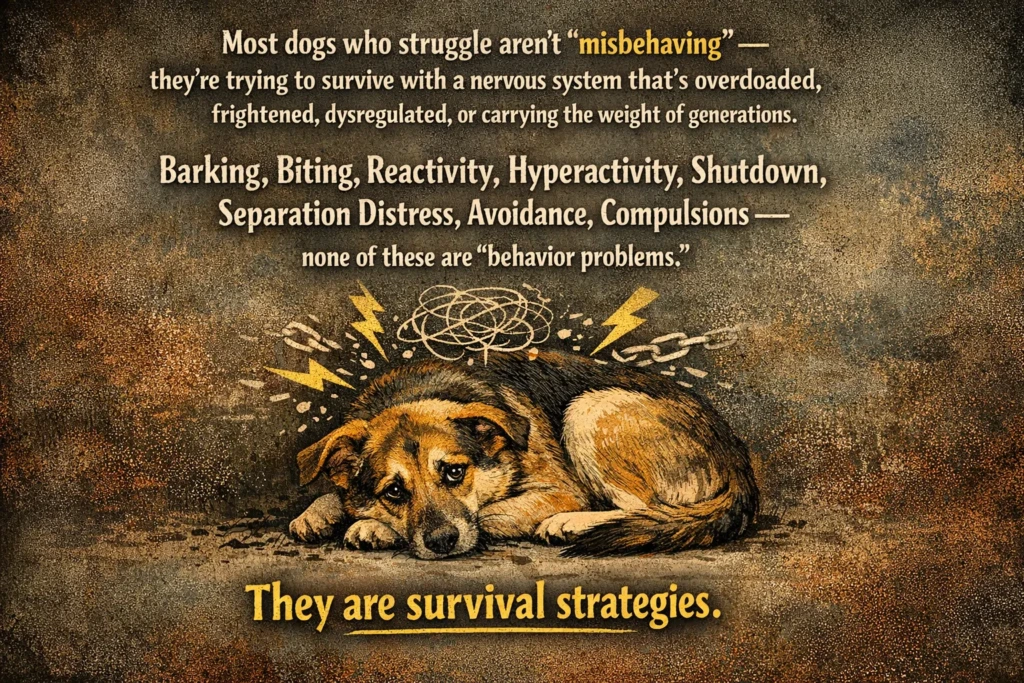
Most dogs who struggle aren’t “misbehaving” —
they’re trying to survive with a nervous system that’s overloaded, frightened, dysregulated, or carrying the weight of generations.
Barking, biting, reactivity, hyperactivity, shutdown, separation distress, avoidance, compulsions —
none of these are “behavior problems.”
They are survival strategies.
A dog’s behavior is not the issue.
The nervous system behind the behavior is.
And until you understand what the nervous system is doing,
training is just pressure in disguise —
a demand for performance from a dog who is already drowning.
Trauma shows up long before anyone sees “bad behavior.”
It shows up as:
- overperception (neuroception stuck on danger)
- chronic hyperarousal
- inherited stress signatures
- maternal stress imprinting
- developmental disruption
- shutdown and dissociation
- compulsive loops
- sensory defensiveness
- emotional instability
- collapse under pressure
None of this can be fixed with obedience, rewards, corrections, or exposure protocols.
Because trauma isn’t a behavior issue.
It’s a state issue.
Change the internal state —
and the behavior shifts on its own.
No training required.
This is what Relational Neuroethology does:
- We regulate before we relate.
- We relate before we request.
- We observe before we interpret.
- We support before we shape.
We don’t fix dogs.
We restore their nervous system so the dog becomes who he actually is —
not who fear, stress, or conditioning forced him to be.
If you want to understand your dog,
stop looking at what he’s doing
and start listening to what his nervous system is saying.
This is where “problem behavior” ends and real understanding begins.