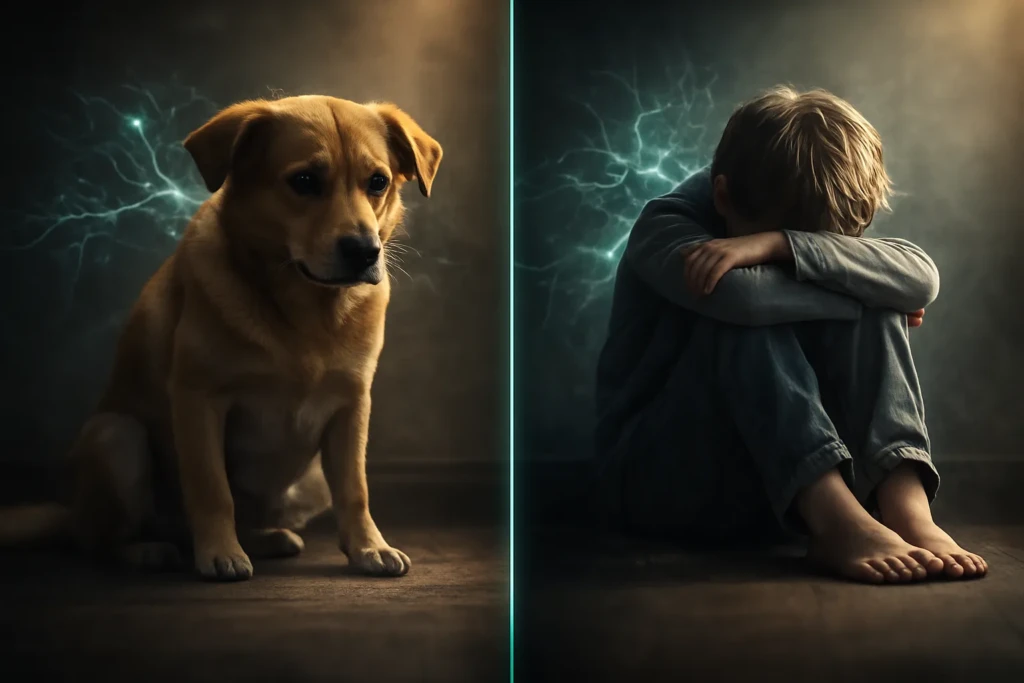
And why the parallels to children are impossible to ignore.
Psychological disorders in dogs are rising at a pace that makes even human mental-health statistics look slow — and those are already alarming.
More anxious dogs.
More compulsive dogs.
More shutdown dogs.
More puppies showing trauma patterns before they’re old enough to understand the world.
People ask, “Why is this happening?”
The answer is brutally simple:
Because we’ve built environments — for children and for dogs — that demand performance instead of connection, compliance instead of safety, and conditioning instead of development.
Both species are collapsing under the same pressure.
1. Nervous Systems Are Overwhelmed — Everywhere
Modern environments are loud, fast, unstable, overstimulating, and emotionally inconsistent.
Children feel it.
Dogs feel it even more.
The nervous system is punched daily by:
- sensory overload
- unpredictable routines
- emotionally absent adults
- social fragmentation
- pressure to adapt instantly
- human stress leaking into the home
Dogs and children share the same evolutionary truth:
they need a stable, regulated adult nervous system to anchor them.
But stable adults are becoming rare.
2. We Expect Performance Instead of Connection
In parenting and dog ownership alike, society shifted from:
“What does this being need?”
to
“How do I make this being behave?”
Children must sit still, self-regulate too early, excel, adapt, not disturb.
Dogs must obey, be convenient, predictable, neutral, quiet.
We replaced:
- safety with structure
- connection with compliance
- relational guidance with training
- emotional presence with performance metrics
And then we diagnose the symptoms we created.
3. Suppression Has Replaced Safety
We reward silence, stillness, obedience, and “good behavior.”
It looks orderly.
It looks polite.
It looks calm.
But suppression is not regulation.
A quiet child may be dissociating.
A quiet dog may be shutting down.
A compliant being may be terrified.
When expression is punished or ignored, the nervous system does what biology demands:
- internalize stress
- escalate anxiety
- develop compulsions
- enter shutdown
- oscillate between panic and numbness
We then label these states as “disorders” — but they are side effects of forced adaptation.
4. Attachment Structures Are Collapsing
Dogs and children depend on:
- predictable adults
- emotional availability
- consistent presence
- relational clarity
- attuned responses
But many adults are chronically:
- exhausted
- distracted
- stressed
- emotionally fragmented
- overburdened
- disconnected from their own bodies
When attachment weakens, regulation collapses — and symptoms explode.
5. Trauma Is Now a Daily Drip, Not a Big Event
We used to think trauma meant catastrophe.
But trauma is also:
- chronic overwhelm
- inconsistent caregiving
- emotional neglect
- unpredictability
- overstimulation
- pressure to perform
Dogs are not traumatized by “abuse only.”
Many are traumatized by modern life:
- chaotic households
- inconsistent humans
- unrealistic expectations
- training that suppresses communication
- environments not built for their biology
- loss of agency
- lack of true relational support
Children face the same world, with the same consequences.
6. The Parallels Are Biological, Not Philosophical
Dogs are masters of reading human emotional states.
They are natural co-regulators.
That means:
When the human system collapses,
the canine system collapses faster.
Children express distress through words, resistance, or withdrawal.
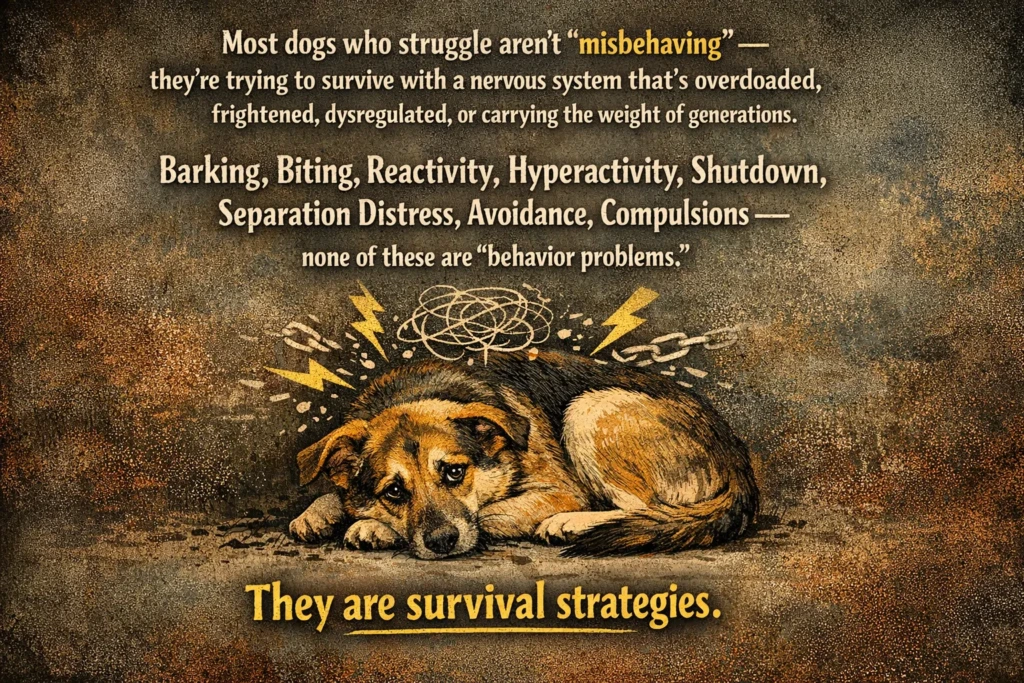
Dogs express distress through “behavior problems,” fear, compulsions, and reactivity.
Neither is misbehaving.
Both are adapting to instability.
7. And Then We Add the Final Blow: The Demand to Function
Here’s the part everyone avoids:
Children and dogs today are expected to function in environments that dysregulate adults.
That alone is enough to break them.
The rules are always the same:
- sit
- stay
- behave
- be manageable
- don’t react
- don’t express
- don’t feel too much
- don’t show distress
- don’t inconvenience anyone
This is not education.
This is not upbringing.
This is not training.
This is conditioning — and conditioning is the foundation of psychological collapse.
💡 Read more about conditioning and the dog`s brain
Conditioning teaches one thing only:
Override your internal world to satisfy external demands.
That is dissociation, not development.
And it is the root cause of the disorders skyrocketing in both species.