
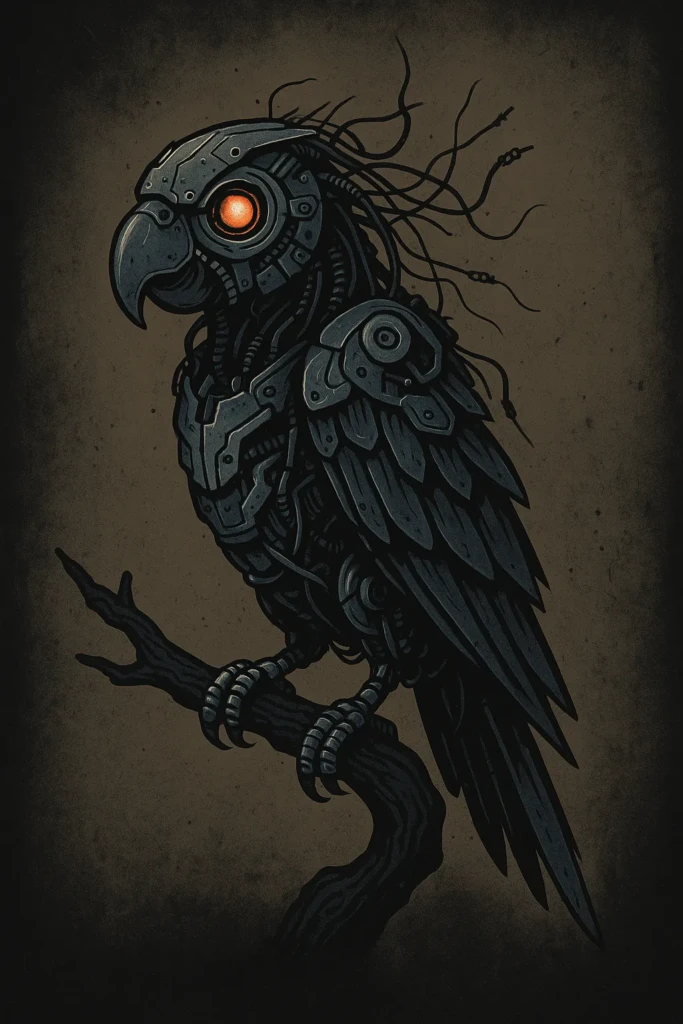
Artificial Intelligence?
Cute term.
There’s nothing “intelligent” about a machine that stitches together pretty sentences without understanding a damn thing.
People treat AI like a digital savior.
In reality, it’s a very fast, very polite parrot with WiFi — confidently repeating whatever nonsense it has eaten from the internet.
Somebody needs to say this out loud.
Fine. I will.
🪓 AI and the real danger
“Why AI Isn’t Intelligent — It’s Just a Polite Parrot With Processing Power”**
1. AI sounds smart — but it UNDERSTANDS nothing.
AI doesn’t read.
AI doesn’t think.
AI doesn’t feel.
AI doesn’t grasp context.
AI doesn’t know right from wrong.
It calculates.
It predicts which word sequence is statistically likely to sound “knowledgeable.”
That’s not intelligence.
That’s autocomplete with better makeup.
AI regurgitates the mainstream because that’s all it knows.
How could AI offer alternatives
if 90% of its training data is:
- obedience dogma
- outdated veterinary behavior models
- dominance myths
- “just medicate the anxiety”
- clicker cult propaganda
- Wikipedia mush
- peer-reviewed but context-blind science
- and social media panic advice?
AI doesn’t choose the truth.
AI chooses the majority opinion.
And the majority opinion is often the intellectual landfill of the animal world.
So when AI tells you:
- “Use positive reinforcement to fix trauma.”
- “Consider SSRIs for fearful dogs.”
- “Ignore shutdown; train the dog out of it.”
- “Fear is a behavior problem.”
…it’s not giving advice.
It’s mirroring the digital echo chamber of collective ignorance.
AI isn’t biased.
AI is the average of all human biases.
AI fails at anything that requires actual understanding.
Ask AI about:
- trauma → “Do you mean fear training?”
- co-regulation → “Sounds like a sport.”
- neurobiology → superficial definitions
- shutdown → misidentified as aggression
- relational leadership → “You mean obedience?”
- dysregulation → “Try training structure?”
The parrot speaks fluently —
but it has no idea what it’s talking about.
This gets dangerous when people treat its confident nonsense as expert guidance.
AI becomes dangerous when humans stop thinking.
The problem is not AI.
The problem is people who want shortcuts.
People who say:
“AI knows better than me.”
“AI must be right.”
“AI gives neutral answers.”
No.
AI gives whatever the statistical mainstream vomits into it.
AI does not know:
- what fear feels like
- what trauma does
- what it means to hold a panicked animal
- what responsibility is
- what ethics are
- what life is
AI knows patterns, not reality.
When humans stop thinking
because AI speaks with confidence, we have a problem.
AI is a tool — but people use it like a religion.
AI can:
- organize
- simplify
- filter
- accelerate
- assist
AI cannot:
- understand
- care
- sense
- judge
- interpret a nervous system
- differentiate trauma from conditioning
- see a living being
Yet people treat it like a prophetic voice.
That’s where the stupidity begins — not in the machine, but in the surrender of human critical thinking.
AI in the animal world?
As dangerous as a loaded gun with no safety.
Because AI:
- doesn’t understand nervous systems
- doesn’t understand trauma
- doesn’t understand relational dynamics
- has zero embodied experience
So you get answers like:
“Reward away the fear.”
“Medicate the anxiety.”
“Correct the behavior.”
“Increase structure and stimulus control.”
Machine logic + living nervous systems = disaster.
A fearful dog isn’t a broken algorithm.
A traumatized animal isn’t a system error.
A shutdown state isn’t “non-compliance.”
And a machine is not a substitute for experience.
Final truth?
AI won’t change the world.
People will — IF they start thinking again.
AI won’t heal.
AI won’t lead.
AI won’t understand.
AI won’t save anyone.
It can help.
It can accelerate.
It can support.
But actual intelligence still requires a human spine, a human brain, and a human heart.
Which is why I’m saying this clearly:
I’m not afraid of AI.
I’m afraid of people who stop thinking because AI speaks for them.
(Written with my favorite AI — trained by me, ruined for everyone else.)

