
Let’s kill the last sacred cow:
Police dogs, military dogs, bomb sniffers, security “assets”—the “heroes” we celebrate with medals, hashtags, and emotional YouTube montages.
Here’s the ugly reality:
They’re not heroes.
They’re conscripts—forced into service, drilled into compliance, and broken for our “safety.”
No dog ever signed up for duty.
No horse ever volunteered for war.
The Myth of the Canine Warrior
Humans enlist for a cause (or a paycheck).
Dogs and horses are drafted—no questions, no choice.
Their “heroics” are our projection; their suffering, our blind spot.
The Drill: Conditioning, Coercion, Collapse
- From puppyhood, they’re molded to fit a job description, not a life.
- Fear, pain, isolation—standard tools of the trade.
- “Toughen up, don’t show weakness, always obey”—sounds familiar? That’s not training, that’s psychological warfare.
- Early burnout, trauma, and emotional breakdowns are the rule, not the exception.
The Disposable Soldier
- When they’re no longer “fit for service”?
They’re retired, re-homed, recycled, or put down.
Sometimes, if they’re lucky, they get paraded one last time as a “retired hero.” Most end up as “problem dogs,” emotionally crippled by a lifetime of institutional abuse. - The “therapy” they get later?
Usually more training, more obedience, more attempts to “fix” what systematic violence broke in the first place.
Love in the Line of Fire – When Loyalty Becomes Tragedy
There’s another truth no one wants to face:
Most handlers love their dogs like family.
They would risk their own lives for them, and sometimes do. There’s real affection, pride, and an unbreakable bond built in the mud and fear of the battlefield.
But here’s the heartbreak:
Love isn’t enough to save these animals from the system.
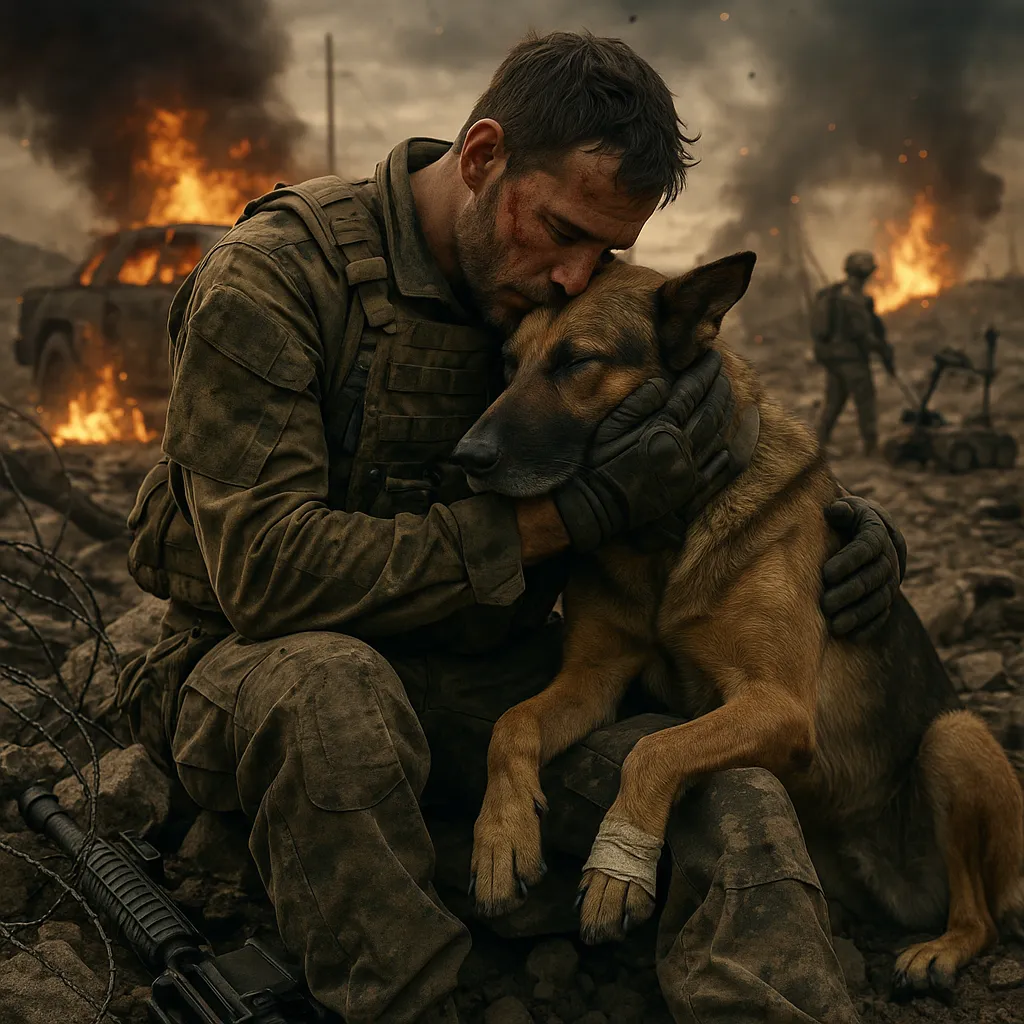
You can hold your partner in your arms, wipe the blood from his fur, whisper promises you mean with all your heart—and still be powerless to protect him from the next mission, the next explosion, the relentless demands of war.
The real tragedy isn’t the absence of feeling.
It’s that even the greatest love can’t rewrite the orders, can’t stop the next deployment, can’t undo the trauma burned into body and soul.
So when you see a soldier with his dog, know this:
They are not just “heroes.”
They are survivors, bound together not just by duty, but by a love that the system will always betray in the end.
The Glory Industry
We call them heroes, but we’re the ones getting the glory:
- Medals, ceremonies, heartwarming stories—meanwhile, the dog pays in fear, pain, and a life lived under orders.
- Their “courage” is a side effect of being given no other option.
The Only Truth Worth Hearing
No animal chooses the battlefield.
No animal is a hero by choice.
They’re victims of our needs, our wars, our pride.
Bottom Line:
Next time you see a police dog, a military horse, or a “war hero” with a wagging tail, remember:
They didn’t choose this.
They’re not volunteers.
They’re conscripts, forced into a war that was never theirs.
The real heroes?
Are the ones who call this out and demand better.
The System: Where Cowardice Hides in Uniform
It’s easy to blame the individual:
the soldier, the handler, the farmer, the “bad apple.”
But the truth is, almost nobody chooses the machine.
They’re born into it, pressured by it, rewarded for going along and punished for standing out.
The real villain isn’t the one holding the leash or wearing the badge.
It’s the system that manufactures compliance—one that trains people to obey, to defer, to never ask “why.”
Uniforms make obedience look noble, and silence look like loyalty.
Ask yourself:
How many actually want this war?
How many would keep marching if “no” was really an option?
Most are trapped—by fear, by economics, by the empty promise of belonging.
That’s why nothing changes:
Because systems thrive on inertia.
It’s always easier to do what’s expected than to refuse.
Real courage isn’t following orders.
Real courage is the first to walk away.
The system fears nothing more than a genuine “no.”
And until enough people—and enough animals—are allowed to say no,
nothing will ever change.

