
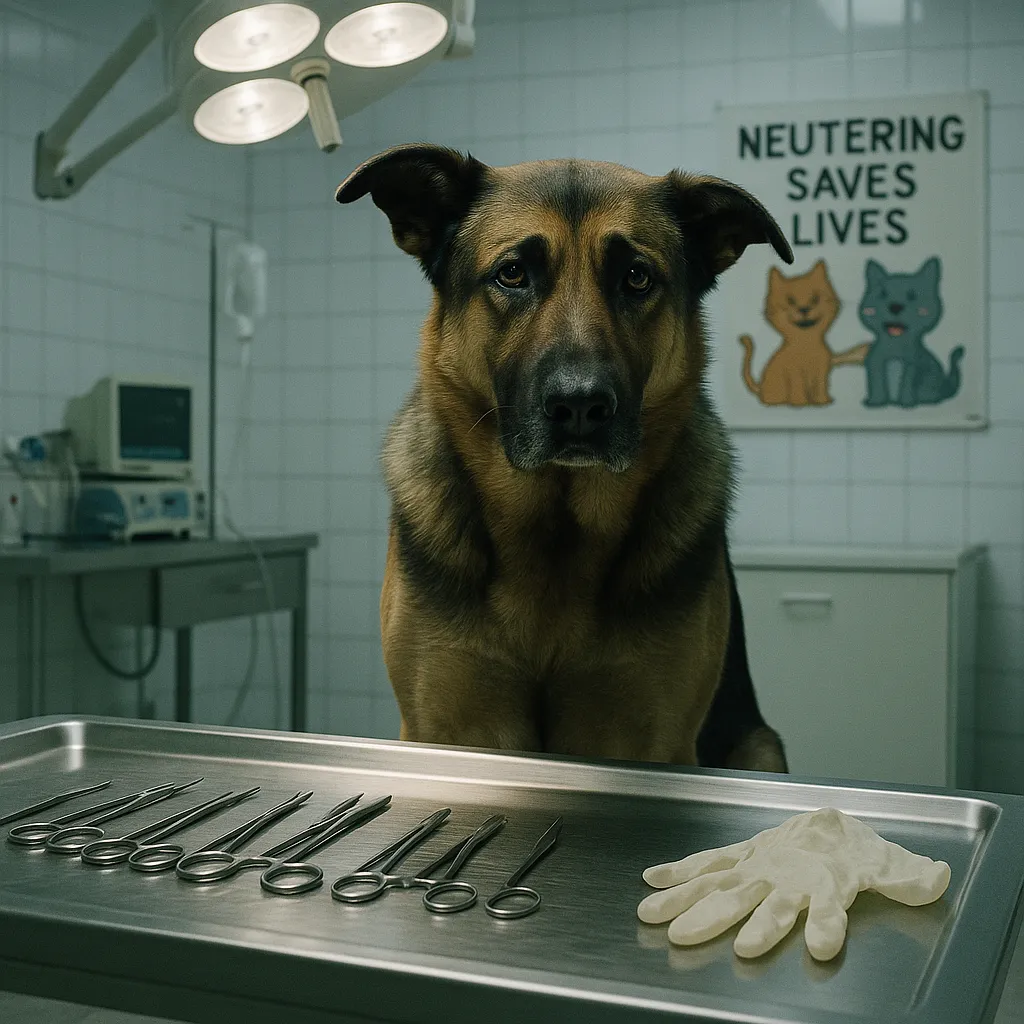
Let’s get one thing straight:
Castration isn’t “responsible ownership.” It’s surgical mutilation—most of the time, for no valid reason.
Forget the mainstream fairy tales about “health benefits” and “behavior improvements.” The truth is uglier, and it stinks of convenience and control—not compassion.
The Biological Wreckage
1. Hormonal Devastation
Neutering isn’t just snipping some parts off and calling it a day. It’s a biological nuke.
Gonads aren’t “optional accessories”—they’re central command for hormone production. Remove them, and you’re setting off a cascade of chronic hormonal imbalances:
- Testosterone and estrogen regulate not only reproduction but immune system, brain function, bone growth, skin health, even the stress response.
- Remove these, and the dog’s system is forced to operate on emergency backup—a hormonal wasteland with all the “classic” side effects:
- Chronic skin issues
- Hair loss or poor coat
- Weight gain
- Lethargy
- Increased anxiety
- Early onset cognitive decline
For the nerds: The pituitary gland goes haywire, the hypothalamic-pituitary-gonadal axis flatlines, and the body is left lurching from one hormonal crisis to the next.
2. The Cancer Myth—Flipped on Its Head
You’ve heard the “neutering prevents cancer” chant, right? Here’s what they don’t print in the glossy pamphlets:
- Bone cancer (osteosarcoma): Statistically higher risk in neutered dogs.
- Hemangiosarcoma: Increased in both spayed and neutered animals.
- Prostate cancer: Risk increases after castration, not the other way around.
- Transitional cell carcinoma (bladder cancer): Also higher risk post-neuter.
Sure, you “eliminate” testicular or ovarian tumors.
But you’re trading one risk for several, far nastier ones.
3. Joint Disaster
Neutering is a fast track to orthopedic problems:
- Hip dysplasia
- Cruciate ligament ruptures
- Elbow dysplasia
- Arthritis before middle age
Why? Because sex hormones regulate healthy bone closure and joint stability. Cut them out, and you’re left with loose, fragile scaffolding.
4. Behavior: The False Promise
The “fix your dog’s aggression” myth is a joke. Scientific reviews show:
- Neutered males often display more fear-based aggression, not less.
- Increased anxiety, reactivity, and even phobias.
- Females? Spaying increases noise phobia, incontinence, and chronic stress behaviors.
Castration doesn’t “calm” a dog. It shoves them into a permanent hormonal twilight zone—nervous, restless, never really at home in their own skin.
What You’re Really Doing: Amputation for Convenience
Don’t kid yourself. Routine neutering is amputation, plain and simple.
You’re taking a healthy organ system and trashing it to tick a social box or avoid a “mess.”
Would you do it to yourself? Didn’t think so.
The Alternatives—If You’re Actually Thinking
- Actual supervision: Try it. It works.
The “Population Control” Excuse
Let’s be honest: Overpopulation is a human management failure, not a biological disease. The dogs pay for our laziness with a lifetime of chronic illness and dysfunction.
Bottom Line:
Castration without medical necessity is mutilation, period.
If you care about health—real health—start with facts, not old wives’ tales or suburban folklore.
Stop calling it “responsible.” Start calling it what it is.

Explanation – Long version – not just for experts
Influence of Endocrinology on Behavior — and the Neuter Myth
How hormones shape the canine mind — and what happens when we amputate an endocrine organ.
Behavior is not an isolated event.
It is the visible end of a chain of internal processes — biological, hormonal, neurological, emotional.
If you study behavior without understanding endocrinology,
you’re reading the last page of a book and assuming you know the whole story.
This lesson explores:
- how hormones shape emotion, cognition, and behavior,
- how endocrine dysregulation produces psychiatric symptoms,
- and why neuter is not a benign routine but an endocrine amputation with far-reaching consequences.
1. The Endocrine System: The Silent Architect of Behavior
Hormones influence:
- mood stability
- emotional reactivity
- attention and focus
- memory
- social confidence
- stress recovery
- impulse control
- affiliative behavior
- energy regulation
- sleep
- sensory sensitivity
- motivation
- resilience
When hormones shift, behavior shifts.
When hormones collapse, behavior collapses with them.
Wolf comment:
Trainers call this “a dog with issues.”
Biology calls it: “a dysregulated organism doing its best to survive.”
2. Key Hormones and Their Behavioral Roles
Cortisol
The regulator of stress, not the creator of it.
Chronically elevated cortisol results in:
- anxiety
- irritability
- poor learning
- fragmented memory
- heightened vigilance
- reduced frustration tolerance
- weakened immunity
A dog living under persistent cortisol load is not “reactive.”
He is drowning.
Oxytocin
The social and attachment hormone.
Supports:
- bonding
- trust
- relational regulation
- emotional buffering
- safe exploration
Low oxytocin → insecure attachment, emotional fragility, and inconsistent social behavior.
Testosterone
Misunderstood as an aggression hormone.
More accurately: a confidence and risk-assessment modulator.
Normal testosterone:
- reduces fear
- stabilizes social behavior
- improves resilience
- supports identity formation in males
Low testosterone (e.g., after neuter):
- increases fear
- increases anxiety-based aggression
- reduces social stability
- increases reactivity
Fun fact:
The aggression neuter supposedly prevents often increases afterward.
Estrogen & Progesterone
Mood, cognition, and impulse-regulation hormones.
Low estrogen:
- increases anxiety
- reduces cognitive flexibility
- heightens stress sensitivity
Low progesterone:
- destabilizes mood
- increases irritability
- reduces emotional inhibition
Thyroid Hormones
The hidden giants of behavior.
Low thyroid hormone can mimic:
- aggression
- panic
- depression
- cognitive fog
- impulsivity
- irritability
Most “behavior cases” in the dog world never receive a proper thyroid workup.
Wolf comment: But sure — let’s talk about obedience instead.
3. When Hormones Change, Behavior Always Changes
Endocrine imbalance can produce:
- fearfulness
- shutdown
- hypersensitivity
- impulsive outbursts
- attention problems
- irritability
- learning difficulties
- clinginess
- aggression
- avoidance
- compulsive patterns
This is not a training problem.
This is endocrine physics.
4. Enter the Cultural Myth: Neuter
We cannot discuss endocrinology and skip the largest endocrine intervention performed on dogs worldwide.
Neuter is sold as:
- preventive medicine
- population control
- behavior improvement
- routine
- responsible ownership
- risk reduction
But biologically, it is none of these.
Here is the truth — and the sentence you wanted:
Neuter is not preventive care, not behavior therapy, and not a harmless routine — it is the surgical amputation of a healthy, functioning endocrine organ, and its removal creates more medical, physiological, emotional, and behavioral problems than it was ever claimed to prevent.
There it is.
No sugar-coating.
No cultural excuses.
Just biology.
5. Physiological Consequences of Neuter (Rarely Disclosed)
Endocrine Collapse
Removing an endocrine organ destabilizes:
- the HPA axis
- mood regulation
- stress buffering
- aggression modulation
- cognitive stability
After neuter, many dogs develop:
- chronic anxiety
- reactivity
- emotional volatility
- confusion
- persistent hypervigilance
Increased Cancer Risk
Especially when neutered early.
Higher incidence of:
- osteosarcoma
- hemangiosarcoma
- lymphoma
- mast cell tumors
- prostate cancer (yes, more common after neuter)
- mammary cancer (age-dependent risk)
Orthopedic Damage
Sex hormones regulate:
- growth plate closure
- ligament integrity
- bone density
Neuter, especially early neuter, leads to:
- ACL tears
- hip dysplasia
- elbow dysplasia
- abnormal limb development
- chronic musculoskeletal pain
Wolf comment:
But sure, let’s call it a “routine wellness procedure.”
Immune Dysfunction
Higher rates of:
- allergies
- autoimmune disorders
- chronic inflammation
Hormones modulate immunity.
Remove them → immunity destabilizes.
Metabolic and Cognitive Effects
Neutered dogs frequently show:
- weight gain (hormonal, not “owner failure”)
- reduced exploratory behavior
- increased anxiety
- altered sleep patterns
- slower learning
- reduced problem-solving
6. Behavioral Consequences of Neuter
The irony is vicious:
Behaviors neuter promises to “fix” often intensify:
- fear aggression
- separation anxiety
- noise reactivity
- resource guarding
- hyperarousal
Why?
Because the dog didn’t have a behavior problem.
He had endocrine regulators —
and we amputated them.
7. What This Means for Professionals
If you ignore endocrinology:
- you misinterpret behavior
- you misdiagnose emotional states
- you recommend harmful interventions
- you confuse stress with stubbornness
- you confuse fear with dominance
- you suppress symptoms instead of healing systems
8. Physical Consequences of Neuter — The Part Most Vets Never Mention
Neuter isn’t just a hormonal shock.
It produces direct, measurable, long-term physical changes throughout the body.
These changes are not “rare side effects.”
They are predictable physiological consequences of removing an endocrine organ.
Orthopedic Changes
Sex hormones regulate bone maturation, growth plate closure, and ligament strength.
Without them:
- growth plates stay open too long
- bones grow disproportionately
- joint alignment shifts
- ligaments weaken
- gait abnormalities become permanent
This increases risk for:
- ACL tears
- hip dysplasia
- elbow dysplasia
- patellar luxation
- chronic lower back pain
- early-onset osteoarthritis
Wolf comment:
If a human surgeon removed your endocrine system at age 8 and said, “He’ll grow out of it,” you’d find a new doctor.
Increased Risk of Certain Cancers
Because sex hormones modulate immune surveillance and cell growth regulation, removing them increases risk for:
- osteosarcoma (bone cancer)
- hemangiosarcoma (blood vessel cancer)
- lymphoma
- mast cell tumors
- prostate cancer (more common after neuter, not before)
- transitional cell carcinoma
This is not speculation — it’s heavily documented in veterinary oncology.
Immune & Inflammatory Changes
Sex hormones balance immune responses.
After neuter:
- autoimmune diseases increase
- allergies increase
- chronic inflammatory conditions rise
- susceptibility to infections increases
The immune system becomes less intelligent without endocrine modulation.
Metabolic Changes
Sex hormones influence:
- insulin sensitivity
- fat distribution
- appetite regulation
- muscle mass maintenance
After neuter:
- metabolism slows
- fat storage increases
- muscle mass decreases
- obesity risk skyrockets
- insulin sensitivity drops
And no — this has nothing to do with “owners feeding too much.”
It is endocrinology.
Neurological & Cognitive Changes
This part is vastly underestimated.
Sex hormones support:
- neuroplasticity
- memory formation
- cognitive flexibility
- resilience
- emotional regulation
After neuter many dogs show:
- decreased learning capacity
- slower information processing
- increased anxiety
- impaired problem-solving
- fragmented sleep
- decreased exploratory behavior
You amputate hormones →
you amputate part of the brain’s regulatory system.

