
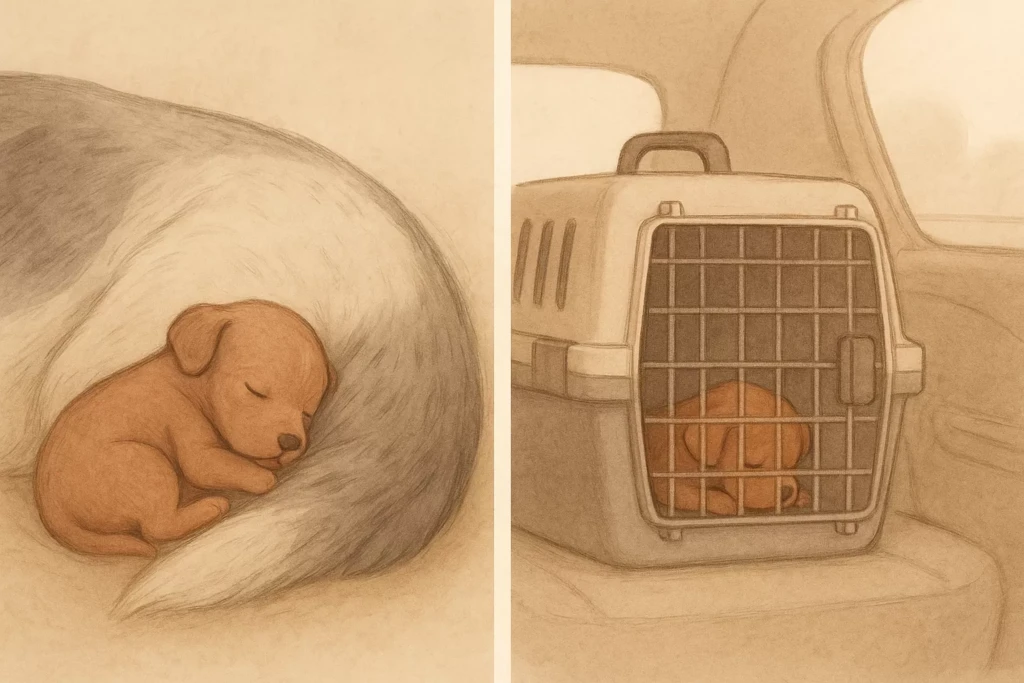
The Invisible Break That Shapes a Lifetime
Every dog is adopted.
This statement irritates people—especially those who have “always had dogs.”
And yet, from a psychological perspective, it is accurate.
Every dog, regardless of where it comes from, is separated from its primary attachment figure and required to reorganize its world around new humans.
That is adoption.
Adoption Is Not an Event — It Is an Experience
Adoption is often treated as a logistical transition:
new home, new people, new routines.
Psychologically, it is something else entirely.
It is the loss of the first attachment system and the forced formation of a new one.
In humans, this experience has been studied extensively. Adoption—especially early adoption—does not disappear simply because the child is young or because the new environment is loving.
Many adopted humans spend decades processing:
- unexplained grief
- attachment insecurity
- heightened vigilance
- fear of loss
- identity fragmentation
Some never fully resolve it.
Not because their adoptive parents failed.
But because early attachment loss leaves a trace.
Dogs Are Not Exempt From This Reality
Dogs are often excluded from this understanding because:
- they adapt quickly on the surface
- they function behaviorally
- they bond visibly
- they do not verbalize loss
None of this means the loss was irrelevant.
A puppy removed from its mother and litter does not “move on.”
Its nervous system reorganizes under separation stress.
That reorganization becomes part of its baseline.
Why This Is So Rarely Acknowledged
The idea that every dog is adopted is uncomfortable.
It challenges comforting narratives:
- that love is enough
- that puppies are blank slates
- that early separation is harmless
- that adaptation equals well-being
It also threatens human self-image.
No one wants to consider themselves the cause of pain—especially when intentions are good.
So the loss is minimized.
Or romanticized.
Or ignored.
What Dogs Learn Through Adoption
At a nervous-system level, adoption teaches one unavoidable lesson:
Attachment can be lost.
How this lesson is integrated depends on what follows.
Some dogs respond with:
- heightened attachment seeking
- hyper-orientation toward humans
- fear of separation
Others respond with:
- emotional distance
- premature independence
- inhibited bonding
Both are adaptive.
Neither is pathological.
But both shape the relationship.
Why “They Bond So Fast” Is a Dangerous Argument
Rapid bonding is often cited as proof that adoption is unproblematic.
It is not.
Fast bonding frequently reflects:
- attachment hunger
- lack of alternatives
- fear of further loss
- nervous system urgency
Bonding speed says nothing about bonding security.
Security takes time.
And consistency.
And protection under stress.
The Ethical Shift This Requires
Recognizing adoption as a psychological experience—not a neutral transition—changes everything.
It shifts the question from:
How do I integrate this dog into my life?
to:
How do I become safe enough to be trusted again?
This is not about guilt.
It is about responsibility.
Dogs do not need to be “grateful.”
They need to be met.
Why This Matters for the Entire Program
From this point on, no dog in this program will be treated as:
- unmarked
- neutral
- untouched by loss
Every dog carries an adoption experience.
Some visibly.
Some quietly.
Some for life.
Ignoring this does not make it go away.
It only ensures misunderstanding.

