—and Always Has Been
Let’s stop pretending this is about animals.
It’s about human arrogance.
Every so‑called “study” on non‑human intelligence starts with the same lie:
That humans are the reference point.
Apes are studied to explain human intelligence.
Dogs are tested to see how close they come to human cognition.
Octopuses, crows, dolphins — all dragged onto the same cheap stage:
Look! They’re almost like us!
That sentence alone disqualifies the entire field.
The Ape Delusion:
Studying animals to validate human superiority**
Primates are not the origin of human intelligence.
That idea is so embarrassingly anthropocentric it should have died decades ago.
A chimpanzee navigating a forest, a social hierarchy, threat dynamics, resource distribution and long‑term memory is not “pre‑human”.
It is operating on a level of situational, embodied, ecological intelligence most humans have completely lost.
The claim that apes are “less intelligent” than humans only works if intelligence is defined as:
- language symbols
- abstract math
- tool fetishism
- self‑referential storytelling
In other words:
skills required for surviving concrete jungles, not real ones.
By any honest biological metric:
A mediocre ape outperforms the average human in perception, integration, social reading, and environmental competence.
And yet we keep running lab tests that ask:
“Can it point? Can it stack blocks? Can it mimic a task?”
Congratulations.
You’ve just proven nothing.
Behavioral Science: The Original Sin
Now let’s talk about the real cancer: behaviorism.
Behavioral science is built on one fatal assumption:
If we can observe behavior from the outside,
we can infer what’s going on inside.
That assumption is logically indefensible.
Behavior is not a cause.
Behavior is an outcome.
It is the surface residue of internal regulation, perception, history, context, and current state.
By focusing exclusively on observable behavior, science did exactly this:
- erased nervous systems
- erased subjective experience
- erased internal coherence
- erased relational fields
- erased meaning
And replaced all of it with stimulus–response superstition.
This single mistake has poisoned:
- animal research
- psychology
- psychiatry
- education
- dog training
- parenting
- leadership theory
Everything that followed is fallout.
Why “Behavior” Is the Worst Possible Entry Point
Behavior tells you nothing unless you already understand:
- internal regulation
- context
- history
- environment
- relational dynamics
Without that, you are doing astrology with clipboards.
Two identical behaviors can come from entirely different internal realities.
And two radically different behaviors can arise from the same internal state.
Behavioral research ignores that because it cannot measure what matters.
So instead of admitting defeat, it did this:
“If we can’t measure it, it doesn’t exist.”
That’s not science.
That’s cowardice.
Intelligence Tests: Measuring Obedience With Extra Steps
Once behaviorism took over, “intelligence testing” became inevitable.
So now we have:
- dogs solving puzzles they were trained to solve
- apes pressing symbols for rewards
- animals completing tasks designed by humans
- under artificial conditions
- for artificial incentives
And the conclusion?
“Look how intelligent they are!”
No.
What you’ve measured is:
- compliance
- pattern learning
- reward sensitivity
- human‑cue reading
- tolerance for boredom
You have not measured intelligence.
You have measured how easily a nervous system can be bent into performing for you.
By that logic, a casino slot machine is brilliant.
The Sea Anemone Problem
Here’s the test no one wants to run:
If you can condition a sea anemone —
and you can —
then conditioning proves nothing about intelligence.
Conditioning requires:
- a sensory pathway
- repetition
- reinforcement
That’s it.
No consciousness.
No meaning.
No awareness.
No relationship.
So when a dog retrieves 200 objects by name,
or an ape presses the “banana” symbol,
or a rat completes a maze —
the only honest conclusion is:
This organism has learned how to interact with your experimental setup.
Nothing more.
Why Non‑Human Research Keeps Failing
Because it insists on:
- human‑centered definitions
- external observation only
- task performance as proxy for mind
- laboratory isolation
- dominance disguised as “method”
And because it refuses the only move that would actually advance science:
Abandon the idea that humans are the gold standard.
Animals are not “less developed humans”.
They are differently organized beings.
Studying them to validate human intelligence is like studying birds to justify walking.
What Real Science Would Require (And Why It Won’t Happen)
Real research into non‑human beings would require admitting that:
- behavior is the least interesting aspect
- internal regulation matters
- subjectivity exists outside language
- relationship alters outcomes fundamentally
- context cannot be controlled away
- observer neutrality is a myth
That would collapse:
- half of psychology
- most of behavioral science
- a good chunk of neuroscience
- and the entire pet‑training industry
So instead, the system protects itself.
**Conclusion:
This Was Never About Understanding Animals**
It was about preserving human centrality.
Behavioral science didn’t misunderstand animals.
It reduced them.
Intelligence research didn’t elevate them.
It domesticated them conceptually.
And the idea that animals exist to help us understand ourselves
is the most unscientific assumption of all.
Every species is proof that life works. Except for humans — living proof that you can be clever, and still miss the point entirely.
In nature, every being adapts or dies trying.
Only humans manage to destroy themselves and everything around them, and write books about how brilliant that is.
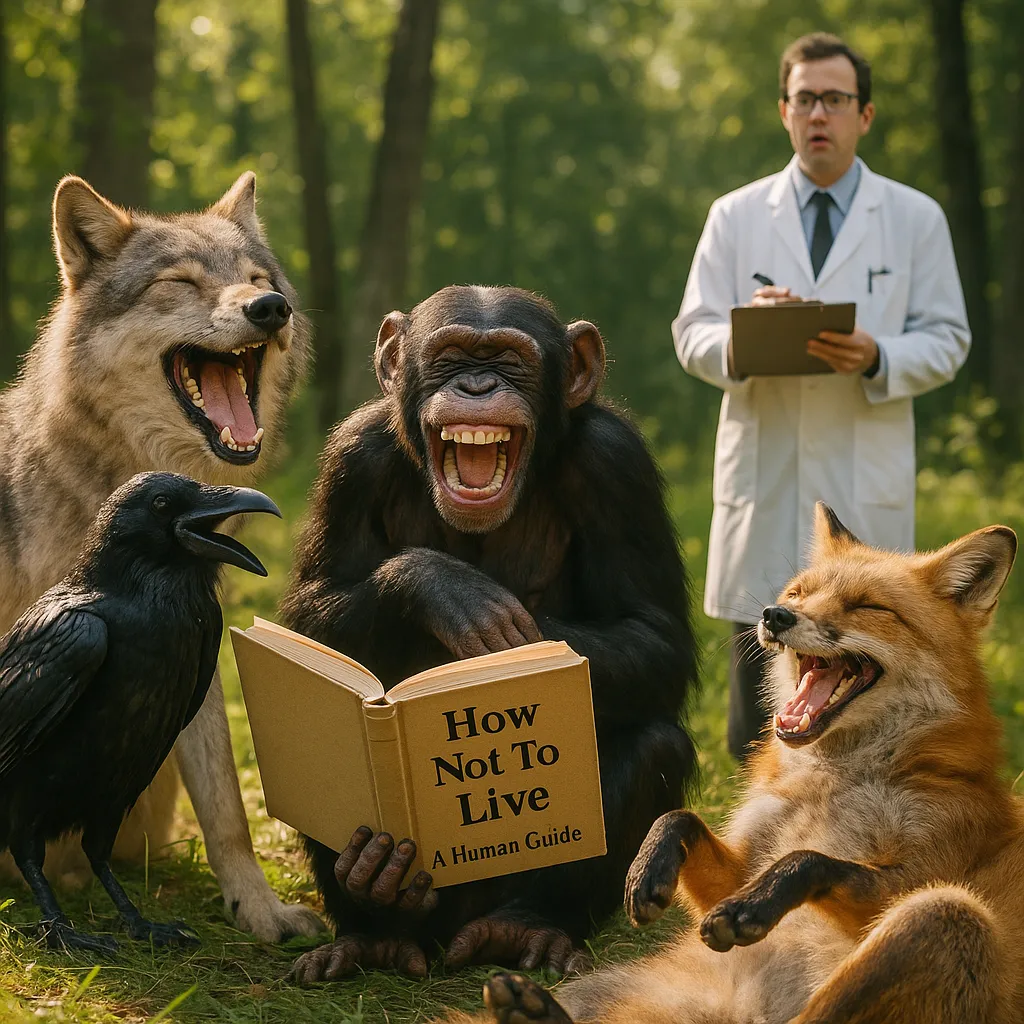
If animals could laugh, they’d never stop.