
Introduction: The Dog World’s Golden Calf
Few myths cling to the dog scene like bubble gum to a coat.
One of the most persistent: “A dog must be well socialized.”
Sounds reasonable, right?
Too bad, in practice, this noble ideal usually means sensory overload, chronic stress, and a complete loss of control—dressed up as “puppy class,” “playgroup,” or “socialization training.”
The Problem:
A shocking number of people genuinely believe that weekly brawls on fenced-in lots are the path to canine social competence.
In reality, what’s being fostered is not social skill but mistrust, aggression, or learned helplessness—depending on whether the puppy is a tough guy or a sensitive soul.
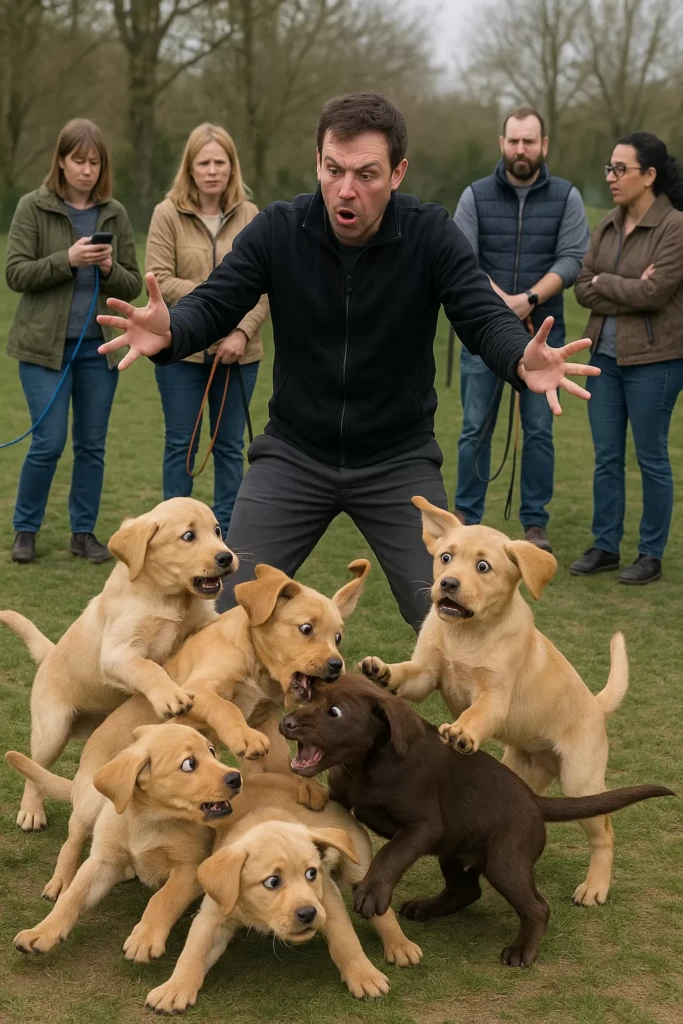
Puppy Groups: The Fast Track to Trauma
Why “starting early” has nothing to do with learning and everything to do with destruction.
There’s a stubborn misconception circulating in dog circles: The earlier a puppy is thrown into a “puppy playgroup,” the better “socialized” it will be.
Sounds logical—until you apply actual canine psychology. From a scientific and clinical perspective, this approach isn’t just outdated. It’s potentially traumatizing.
A random mob of unfamiliar puppies, tossed together with strangers in a harsh, over-stimulating environment—this isn’t “play.”
It’s a textbook case of uncontrolled overstimulation, where puppies learn only one lesson:
The world is unpredictable, unsafe, and no one is coming to help me.
Why Puppy Groups Are a Train Wreck Waiting to Happen
1. Neurological Overload
Puppies are in a highly sensitive developmental window. Their nervous systems aren’t equipped to process or recover from chronic stress. Overexposure to new stimuli doesn’t build resilience—it just forges new pathways to anxiety.
2. No Safe Attachment
Instead of learning in safety, guided by their human, puppies are tossed into a foreign group—no escape, no fallback. Trust gets destroyed before it even has a chance to form.
3. Learned Lesson: Humans Won’t Protect Me
If a puppy is chased, bullied, or bitten while the human stands by, the message sinks deep: “My person won’t protect me.” That’s the exact opposite of building a secure bond.
4. “Socialization” as a Bad Joke
What’s sold as “play” is usually mobbing, chaos, and stress-induced wrestling until someone drops. Anyone calling that “healthy” has no clue about canine behavior.
The “Start Young” Myth
The classic “start ‘em young” mantra isn’t rooted in behavioral science but in a time when dogs were supposed to obey, not feel secure.
Anyone still pushing this agenda is selling old-school obedience logic: Get the dog to submit early.
Bonding? Emotional safety? Never heard of it.
The Alternative: Attachment-Based Protection Phase
Here’s how it works in attachment-focused canine psychology:
– Priority one: Safety and protection from overload.
– Companionship: New experiences are introduced slowly, in the presence and under the protection of a trusted human.
– Pace: Individually adapted—not dictated by a calendar or age chart.
– Quality over Quantity: It’s not about the number of “contacts.” It’s about the depth and safety of experience.
Conclusion
Puppy groups aren’t just unnecessary—they’re often the opening act in a long series of trust violations.
If you want a dog who is truly socially secure, start with bonding, protection, and guidance.
Everything else is just window-dressing on a hidden wound.
If you want to make sure your puppy’s first trauma isn’t served up before the baby teeth are out, skip the group “fun” and invest in real, science-based, attachment-focused guidance.
